🧢 Beautiful ✨ Detailed πŸ’ Adorable

Yumi the Dachshund Bicolor Amigurumi Pattern

Yumi the Dachshund Bicolor Amigurumi Pattern
4.6β˜… Rating
5-7 Hours Time Needed
2.3K Made This
βœ‚οΈ

Intermediate Level

Ideal for those with basic crochet experience, featuring slightly more advanced stitches and techniques to expand your skills.

⏱️

Weekend Treat

Takes 5-7 hours, making it an enjoyable project to finish over a couple of days.

🧸

Cute Companion

An adorable friend to cherish, handcrafted with love to bring comfort and joy for years to come.

About This Yumi the Dachshund Bicolor Amigurumi Pattern

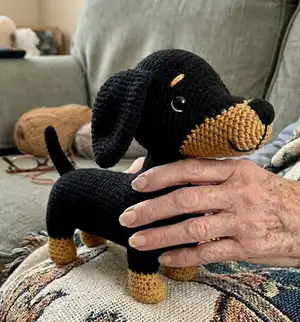
This is an add-on to the original "Yumi the Dachshund" pattern showing how to crochet a bicolor dog. The pattern covers head shaping, ears, legs and detailed color-change techniques used to create the contrasting muzzle and paws. It includes embroidery and assembly tips so your finished dachshund looks neat and expressive.

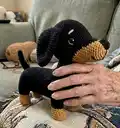
Yumi the Dachshund Bicolor Amigurumi Pattern crochet pattern - detailed view of completed project

Designed to be worked in continuous spirals, the instructions explain where to change colors and how to mark points for eyes. Photo references and step notes help you place eyes, sew ears and embroider facial details accurately.

Why You'll Love This Yumi the Dachshund Bicolor Amigurumi Pattern

I absolutely love this pattern because the bicolor details instantly add personality and charm to a classic amigurumi dachshund. I enjoy the color-change technique β€” it creates a crisp muzzle and paws that look professional. The shaping in the head and ears gives a sweet, realistic silhouette that I find irresistible. Working the embroidery and small finishing touches makes each dog feel unique and handmade with care.

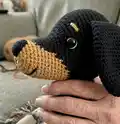
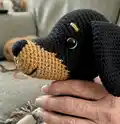
Yumi the Dachshund Bicolor Amigurumi Pattern step 1 - construction progress Yumi the Dachshund Bicolor Amigurumi Pattern step 2 - assembly progress Yumi the Dachshund Bicolor Amigurumi Pattern step 3 - details and accessories Yumi the Dachshund Bicolor Amigurumi Pattern step 4 - final assembly and finishing

Switch Things Up

I love personalizing this pattern by changing the color palette; try soft pastels for a baby-friendly toy or bold brights for a playful look.

Want a larger or smaller dog? Change yarn weight and hook size β€” bulky yarn with a larger hook gives a chunky cuddly version while fingering yarn creates a tiny collectible.

I sometimes add tiny crocheted props like a scarf, bow or tiny toy ball to make each dog unique and gift-ready.

For a poseable version, consider adding thin wire inside the legs or tail so you can bend them slightly for display.

Swap safety eyes for embroidered eyes for a fully baby-safe toy, and use contrasting embroidery to emphasize expression.

Experiment with stripes or a patterned sweater by changing colors every few rounds on the body β€” it's an easy way to add personality.

I often adjust eyebrow placement and mouth shape with embroidery to make the face look sleepy, happy, or curious.

Try felting or sewing on small felt patches instead of color changes for a textured, patchwork style.

If you want a keychain or bag charm, make a mini version using thinner yarn and a 1.5 mm hook, and attach a small keyring to the top.

I recommend testing small swatches when changing yarn or hook sizes so you can predict final proportions and adjust stitch counts as needed.

Common Mistakes & How to Fix Them

βœ— Skipping stitch markers during long spiral rounds will make it hard to find the start of a round; place a marker at the start of each round to keep your counting accurate. βœ— Changing colors incorrectly can create loose loops or gaps at the join; always wrap the new yarn over the hook with the two loops from the previous yarn and pull through both loops to secure the color change. βœ— Not stuffing as you go can lead to lumps or difficulty shaping the head and muzzle; stuff gradually and continue stuffing while you crochet to maintain an even shape. βœ— Forgetting to mark eye placement will result in uneven placement; mark points for eyes in the indicated round (rnd 19) with contrast thread before installing safety eyes. βœ— Pulling tension too tight when working color transitions can distort the shape; keep a consistent, moderate tension when switching colors and counting stitches carefully. βœ— Leaving yarn tails too short after fasten off makes finishing harder; always leave long tails for sewing and use the tapestry needle to weave and hide ends neatly.

Yumi the Dachshund Bicolor Amigurumi Pattern

Make a charming bicolor Yumi the Dachshund with this detailed add-on pattern. You will get step-by-step instructions for the head, ears and legs, including color-change techniques and embroidery tips. Perfect for creating a small, cuddly dachshund with bright contrast details. Follow the full rounds and photo notes to get neat color transitions and a polished finish.

Intermediate 5-7 Hours

Materials Needed for Yumi the Dachshund Bicolor Amigurumi Pattern

β€” Main Fabric

  • 01
    Cotton yarn - black: 40g / 128m (140 yards)
  • 02
    Cotton yarn - mustard: 15g / 48m (54 yards)
  • 03
    Cotton yarn - white: 5g / 16m (18 yards)
  • 04
    Sample yarns used: YarnArt Jeans (semi cotton yarn) black #28, mustard #84; Alize Cotton Gold (semi cotton yarn) white #55, grey #21

β€” Tools Required

  • 01
    Crochet hook size 2.0mm (size C)
  • 02
    A pair of 10 mm (0.5") safety eyes
  • 03
    Polyfill to stuff
  • 04
    Tapestry needle
  • 05
    Stitch markers and pins
  • 06
    Scissors

Progress Tracker

0% Complete

β€” Head :

Info :

All details are crocheted in continuous spirals, without joining the rounds. You can use a stitch marker to keep track of your rounds. Start with color B

Round 01 :

6 sc into the center of magic adjustable ring, pull tail to close the ring (6)

Round 02 :

(inc) 6x (12)

Round 03 :

(sc, inc) 6x (18)

Round 04 :

(2sc, inc) 6x (24)

Round 05 :

sc in each st around (24)

Info :

In next rnds the color of yarn will be changed alternately:

Info :

How to change the color yarn: with the two loops from the previous yarn on the hook, wrap new yarn over the hook (image 1.1) and pull it through the two loops of the stitch. (image 1.2) It is important to remember, that the color change must always be started one stitch earlier.(image 1.3)

Round 06 :

color B (next - B): 6sc, color A (next - A): 4sc, B: 14sc (24)

Round 07 :

B: 5sc, A: 6sc, B: 13sc (24)

Round 08 :

B: 4sc, A: (dec, sc) 2x, dec, B: 12sc (21)

Round 09 :

B: 3sc, A: 7sc, B: 4sc, (inc, 2sc) 2x, inc (24)

Round 10 :

B: 3sc, A: 7sc, B: 14sc (24)

Round 11 :

B: 2sc, A: 9sc, B: 13sc (24)

Round 12 :

B: 2sc, A: 5sc, inc, 3sc, B: 4sc, inc, 7sc, inc (27)

Round 13 :

B: 2sc, A: 10sc, B: 15sc (27)

Round 14 :

B: sc, A: 12sc, B: 14sc (27)

Round 15 :

B: sc, A: 7sc, inc, 5sc B: 3sc, inc, 8sc, inc (30)

Round 16 :

A: 16sc, B: 13sc, A: sc (image 1.4) (30)

Round 17 :

A: 4sc, (inc, sc) 4x, inc, 4sc, B: 11sc, A: 2sc (35)

Round 18 :

A: 5sc, (inc, 2sc) 4x, inc, 5sc, B: 9sc, A: 3sc (40)

Info :

In next rnd we should mark points for eyes:

Round 19 :

A: 4sc, with a contrast thread mark here a point for the first eye (image 1.5), 19sc, mark here a point for the second eye, 6sc, B: 7sc, A: 4sc (40)

Round 20 :

A: (inc, 3sc, inc, 7sc) 2x, inc, 3sc, inc, sc, B: 5sc, A: 5sc (46)

Round 21 :

A: 37sc, B: 3sc, A: 6sc (18)

Info :

For the next rnds use color A only:

Round 22 :

sc, (inc, 4sc, inc, 8sc) 2x, inc, 4sc, inc, 11sc (image 1.6) (52)

Round 23-29 :

(7) sc in each st around (52)

Info :

If you use safety eyes, it is the best moment to place them. Place them in points we marked earlier in rnd 19. (image 1.7)

Round 30 :

(11sc, dec) 4x (48)

Round 31 :

3sc, (dec, 6sc) 5x, dec, 3sc (42)

Round 32 :

(5sc, dec) 6x (36)

Info :

Start stuffing the head with filling material. And continue stuffing it during crocheting.

Round 33 :

2sc, (dec, 4sc) 5x, dec, 2sc (30)

Round 34 :

(3sc, dec) 6x (24)

Round 35 :

sc, (dec, 2sc) 5x, dec, sc (18)

Round 36 :

(sc, dec) 6x (12)

Round 37 :

(dec) 6x (6)

Info :

Fasten off, leaving a long tail. Using tapestry needle, weave the yarn tail through the front loop of each remaining stitch and pull tight to close. Weave in the yarn end. (image 1.8)

β€” EARS (make 2) :

Info :

Start with color A

Round 01 :

ch10, sc in 2ndch from hook and remaining 7sc, inc in the last st, turn and continue on the other side of a chain 8sc, inc in the last st (image 2.1) (20)

Round 02-03 :

(2) sc in each st around (20)

Round 04 :

(9sc, inc) 2x (22)

Round 05 :

(10sc, inc) 2x (24)

Round 06 :

(11sc, inc) 2x (26)

Round 07 :

(12sc, inc) 2x (28)

Round 08-13 :

(6) sc in each st around (28)

Round 14 :

(12sc, dec) 2x (26)

Round 15 :

(11sc, dec) 2x (24)

Round 16 :

(10sc, dec) 2x (22)

Round 17 :

(9sc, dec) 2x (20)

Round 18 :

(8sc, dec) 2x (18)

Round 19 :

(7sc, dec) 2x (16)

Round 20 :

Crochet 3sc, then flatten an ear and line up stitches, 8sc through both sides to the end (image 2.2) (8)

Info :

Fasten off, cut the yarn, leaving a long tail for sewing. (image 2.3)

Info :

Sew ears to the both sides of a head between 22 and 31 rnds of a head. The distance between ears - 15sc along the 23rd rnd of a head. The distance between ear and eye - 3sc up from the eye. (image 2.4, 2.5, 2.6)

Info :

Take a piece of color A yarn and tapestry needle, insert needle from under the head (level of of 25th rnd) (image 2.7) and bring it out right next to the eye, and insert it back on the opposite side of an eye (image 2.8, 2.9), then bring it back down under the head, one stitch from the entry. Repeat with the second eye, inserting the needle in the same points from the bottom (image 2.10). Then properly pull all yarn ends and, keeping yarn tension, tie a knot of all yarn ends, hide an ends. (image 2.11, 2.12)

Info :

Take a piece of black yarn and embroider the nose between 1 and 7 rnds of a head's top part. The size of a nose - 5sc in height, 3sc - the bottom side, 7sc - the top side. (image 2.13, 2.14)

Info :

Embroider the line from the bottom of a nose to the 3 rnd of the head's bottom part. Then embroider a smile to the both sides from the line between 3 and 8 rnds of a head. (image 2.15, 2.16)

Info :

With the color B yarn embroider the eyebrows, placing them between 20 and 22 rnds over eyes (make 2 loops of yarn). The length of the eyebrow - 2sc, the height - 1sc. (image 2.17)

Info :

With the white yarn embroider lines under the eyes (image 2.17).

β€” LEGS (make 4) :

Info :

Start with color B

Round 01 :

ch5, sc in 2ndch from hook and remaining 2sc, 3sc in the last st, turn and continue on the other side of a chain 3sc, 3sc in the last st (image 3.1) (12)

Round 02 :

(3sc, 3inc) 2x (18)

Round 03 :

This rnd work with back loops only (image 3.2) sc in each st around (18)

Round 04 :

sc in each st around (18)

Round 05 :

sc, 6dec, 5sc (12)

Round 06 :

sc in each st around (12)

Info :

Change yarn to color A

Round 07 :

2sc, 3inc, 7sc (15)

Info :

The next rnd will be different for each leg.

For a back right leg :

Round 08: 3sc, (inc, sc) 2x, inc, 7sc. Make slst. Fasten off, cut the yarn. Attach a pink marker on the 3rd st from the last slst. (image 3.3)

For a back left leg :

Round 08: 3sc, (inc, sc) 2x, inc. Make slst. Fasten off, cut the yarn. Attach a green marker on the 3rd st from the last slst.

For a front left leg :

Round 08: 3sc, (inc, sc) 2x, inc, sc. Make slst. Fasten off, cut the yarn. Attach a yellow marker on the 3rd st from the last slst.

For a front right leg :

Round 08: 3sc, (inc, sc) 2x, inc, 7sc. Make slst. Fasten off, cut the yarn. Attach a blue marker on the 3rd st from the last slst. (image 3.4)

Info :

The next process is the same, as in the main pattern, so next follow the main pattern since page 6 (body), but use colors you chose for your dog.

Assembly Instructions

  • Sew ears to both sides of the head between rounds 22 and 31 of the head. Space the ears 15sc along the 23rd round and position each ear 3sc up from the eye for symmetry.
  • Install safety eyes at the marked points from round 19 before closing the head, then secure and hide ends using the tapestry needle technique described.
  • Using a tapestry needle and color A yarn, run the thread from under the head (level of 25th rnd) out next to the eye and back on the opposite side to define eye placement; repeat for the second eye and tie knots to hide ends.
  • Embroider the nose between rounds 1 and 7 of the head top: 5sc height, 3sc bottom side, 7sc top side. Embroider a line from the bottom of the nose to round 3 of the head bottom and add a smile between rounds 3 and 8.
  • Embroider eyebrows with color B between rounds 20 and 22 above the eyes (make two loops of yarn, length 2sc, height 1sc) and use white yarn to embroider lines under the eyes.
  • Attach legs to the body following the main pattern attachment instructions, using the color markers placed at the 3rd stitch from the last slst of each leg to ensure correct positioning.

Important Notes

  • πŸ’‘Make sure you crochet pretty tight all the way to avoid stretching holes between the stitches after filling with stuffing material.
  • πŸ’‘Use stitch markers to keep track of the start of each spiral round, especially when working long rounds and color changes.
  • πŸ’‘Start stuffing the head early and continue stuffing as you decrease to maintain a smooth shape and avoid lumps.
  • πŸ’‘Place safety eyes when indicated (after rnd 23-29) to ensure correct positioning and a neat finish.
  • πŸ’‘Leave long yarn tails when fastening off to make sewing and weaving in ends easier during assembly.

This bicolor Yumi the Dachshund add-on brings delightful contrast details to the original pattern and makes your toy pop with personality. Follow the color-change and embroidery tips here to achieve crisp, professional-looking features for muzzle, paws and eyes. Enjoy making a small, handmade companion full of charm and character. 🧢🐾

You ask,

we answer.

FAQs

What size will the finished piece be?

The finished amigurumi measures approximately 7.5" (19 cm) height and 7" (17 cm) wide using the recommended yarn and 2.0 mm hook.

Can I use different yarn weights for this pattern?

Yes, you can use different yarn weights but this will change the final size; choose an appropriate hook for your yarn and expect size differences.

Do I need experience with color changes?

This pattern is rated intermediate because it uses frequent color changes and shaping techniques; basic experience with single crochet, increases and decreases is recommended.

When should I place the safety eyes?

Place the safety eyes after round 23-29 when you have marked the points in round 19; the pattern indicates this is the best moment for installation.

How do I avoid holes at color changes?

Use the recommended color-change method: with the two loops of the previous yarn on the hook, wrap the new yarn and pull through both loops, and always start the color change one stitch earlier to close gaps.