🧢 Beautiful ✨ Detailed πŸ’ Adorable

Watermelon Coleus Pattern

Watermelon Coleus Pattern
4.3β˜… Rating
12-15 Hours Time Needed
2.5K Made This
βœ‚οΈ

Intermediate Level

Ideal for those with basic crochet experience, featuring slightly more advanced stitches and techniques to expand your skills.

⏱️

Multi-Day Project

A rewarding 12+ hour journeyβ€”perfect for dedicated crafters who love detailed work.

🏑

Cozy Accent

A warm touch for your space that transforms ordinary corners into inviting nooks filled with handmade charm.

About This Watermelon Coleus Pattern

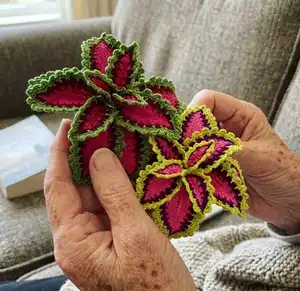
This pattern teaches you how to crochet a realistic Watermelon Coleus plant with layered leaves, long stitch edging and wire stems for shaping. It uses DMC Petra no5 3ply cotton and works over florist wire to create sturdy, poseable leaves. Detailed photos and explanations are included for the unusual long-stitch sequences used in the edging.

Watermelon Coleus Pattern crochet pattern - detailed view of completed project

The pattern makes a 12-leaf plant approx. 7" (18cm) tall and 9" (23cm) wide depending on shaping. You can scale the size by changing yarn weight or the number of leaves for larger or smaller displays.

Why You'll Love This Watermelon Coleus Pattern

I absolutely love this pattern because it transforms simple crochet stitches into lifelike, textured leaves that really sing when layered together. I enjoy the creative challenge of the long-stitch technique β€” it produces an elegant scalloped edge that looks like real Coleus leaf serration. The use of florist wire gives the leaves structure and lets you pose the plant for a natural finish. Making this project feels like sculpting with yarn, and I love how the vibrant color combinations bring instant personality to any room.

Watermelon Coleus Pattern step 1 - construction progress Watermelon Coleus Pattern step 2 - assembly progress Watermelon Coleus Pattern step 3 - details and accessories Watermelon Coleus Pattern step 4 - final assembly and finishing

Switch Things Up

I love how easily you can customize this pattern by swapping colours β€” try pastel pinks and mint greens for a soft, modern look.

I often change yarn weight and hook size to create a family of plants in different scales for a shelf display.

You can replace florist wire with thinner gauge for a more delicate bend or thicker wire for strong posability; I like using 3.5mm for large statement leaves.

I also add tiny embroidered veins or a dab of paint for extra realism on some leaves when I want a weathered or shaded effect.

Make mini keychain versions by using fine cotton and a smaller hook, then shorten the wire and secure with a small eye pin.

For a different finish, use variegated yarns to create natural gradient leaves without changing colours manually.

I sometimes attach several leaves to a single wrapped stem and cover the join with floral tape to create fuller rosettes.

If you want seasonal decor, swap the greens for autumn tones and add tiny crocheted flowers for a fall planter.

I like to experiment with different pot fillers β€” pebbles, sand, or moss β€” to match the look to my home decor.

Finally, try grouping plants of different sizes and colours to make a striking centerpiece; it's a great way to show off colorwork and shaping skills.

Common Mistakes & How to Fix Them

βœ— Skipping the instruction to crochet over the wire will make the leaf unstable; be sure to insert and crochet the wire round as indicated so the wire is securely wrapped. βœ— Not changing color at the correct point results in muddled leaf veins; follow the colour-change lines exactly to maintain crisp inner and outer color zones. βœ— Pulling long stitches too tight will flatten the scalloped edge; maintain a gentle, even tension when working Long hdc/dc/tc to keep the decorative edge lifted. βœ— Forgetting to pull the wire round and down equally can distort the leaf tip; after inserting wire, pull it evenly to place the wire centrally through the leaf. βœ— Skipping the slip stitch into the base chain causes misalignment on the second side; always slst into the base chain/stitch indicated to keep symmetry.

Watermelon Coleus Pattern

Make your own realistic Watermelon Coleus plant with this detailed crochet pattern. You will learn long-stitch techniques, work over florist wire for shaped leaves, and combine vibrant color changes to recreate the signature watermelon-style foliage. The pattern includes step-by-step instructions, photos, and tips so you can create a potted decorative plant perfect for gifting or home display.

Intermediate 12-15 Hours

Materials Needed for Watermelon Coleus Pattern

β€” Main Fabric

  • 01
    DMC Petra no5 crochet cotton, 3ply (recommended)
  • 02
    Plant 1 Color 53607 (pink/magenta tone)
  • 03
    Plant 1 Color 5550 (deep purple/maroon tone)
  • 04
    Plant 2 Color 53803 (bright pink/magenta)
  • 05
    Plant 2 Color 5938 (brown/darker tone for accents)
  • 06
    Green accent 5907 (light green for edges)
  • 07
    Green accent 5905 (leaf green for edges and stems)

β€” Tools Required

  • 01
    Crochet hook size 1.5mm
  • 02
    Alternative yarn: 4ply or crochet cotton no.10 with appropriate hook
  • 03
    Garden wire 2mm, 3mm or 3.5mm (stem wire) optional - 3.5mm recommended for this project
  • 04
    Florist wire (26 gauge or thicker) for inside leaves
  • 05
    Green floral tape
  • 06
    Styrofoam or dry florist sponge for pot filler (if using a plant pot)
  • 07
    Safety pot or plant pot (optional)
  • 08
    Scissors
  • 09
    Yarn needle for sewing and weaving ends
  • 10
    Stitch markers
  • 11
    Pliers or wire cutters for trimming wire

Progress Tracker

0% Complete

β€” Pattern Notes :

Info :

Notes: When you see stitches in brackets, it means that all the ones in the bracket are worked in to one stitch. Example: (sc inc) means: 2sc worked in to one stitch. (3sc) means: 3sc in the same stitch. (3sc) x 2 means: 3sc in each of the next 2 stitches. Alternate (dc inc) and 1dc x 3 means: work 2dc in to the first stitch, then work 1dc in the next, then repeat the last 2 steps 2 more times.

Info :

Following the tutorial and using the recommended yarn, your finished plant will measure approx. 7"(18cm) tall without plant pot and 9"(23cm) in width Depending on how you shape the leaves. This plant is made of 12 leaves in total as shown in the image. However you can make it larger by making more leaves or smaller by making less leaves.

β€” Leaf A :

Make 4 :

Make 4 leaves of type A

Round 1 :

Ch25 Skip1 2sc 1hdc 1dc (dc inc) x 2 9dc 4hdc 3sc

Round 1 continued :

(3sc) in the last chain

Round 1 return :

3sc 4hdc 9dc (dc inc) x 2 1dc 1hdc 2sc

Round 1 finish :

(3sc) in the skipped chain from the beginning

Round 2 :

2sc 2hdc 1dc (dc inc) (1dc, 1tc) 1tc (tc inc) repeat the last 2 steps 1 more time 3tc 4dc 4hdc 3sc

Round 2 center :

(3sc) center stitch, Going down the other side, 3sc 4hdc 4dc 3tc

Round 2 tip :

(tc inc) 1tc repeat the last 2 steps 1 more time (1tc, 1dc) (dc inc) 1dc 2hdc 3sc slst base chain

Round 3 :

ch1 8sc (sc inc) 1sc repeat the last 2 steps 2 more times 17sc

Round 3 info :

Work all the following stitches in to the center stitch at the tip of the leaf: (1hdc, ch4, skip1, 1sc, 1hdc down the chain, 1hdc). Pull the wire round and down equally

Round 3 continued :

17sc 1sc (sc inc) repeat the last 2 steps 2 more times 8sc Slst in 1st stitch on the opposite side

Info :

CHANGE COLOUR

Leaf A Wire insertion :

We will now crochet over the florist wire. Cut a piece of approximately 20"(50cm) and thread it through the stitch on your hook (p1 & 2). Crochet this whole next round over the wire.

Round 4 :

ch1 4sc 1hdc

Round 4 long stitch info :

Then work the first Long stitch sequence. Work 1hdc, Yarn over as to work another hdc but don't work it in to the next chain. Instead insert the hook in to the round below (underneath the wire round) and 1 stitch back. Pull the yarn through as you would usually do and pull the long stitch up. Now pull through to complete the Long hdc the same as you would usually do. So now you have done this sequence: (1hdc, 1Long hdc). In the next chain work 1 slip stitch. This chain may be hidden under the Long stitch so just check to make sure the slip stitch is worked in to the correct chain.

Round 4 continued :

ch1 4sc 1hdc 1hdc (1hdc, 1Long hdc) Slst

Round 4 continue :

1dc (1dc, 1Long dc) Slst

Round 4 continue 2 :

1dc (1tc, 1Long tc) Slst Repeat 3 more times

Round 4 continue 3 :

1dc (1dc, 1Long dc) Slst Repeat 1 more time

Round 4 continue 4 :

1hdc (1hdc, 1Long hdc) Slst Repeat 1 more time

Round 4 center :

2sc (3sc) center stitch

Round 4 going down other side :

2sc slst 1hdc (1hdc, 1Long hdc) Repeat 1 more time slst 1dc (1dc, 1Long dc) Repeat 1 more time slst 1dc (1tc Long tc) Repeat 3 more times slst (1dc, 1Long dc) 1dc slst (1hdc, 1Long hdc) 1hdc

Round 4 finish :

5sc slst in 1st stitch on the opposite side

Round 5 :

ch1 4sc slst (in to the row below)

Round 5 shell instructions :

1sc 1hdc (hdc inc) slst (side of slst from the row below) Repeat 9 more times

Round 5 center :

3sc (1sc, ch3, skip1, 1sc, 1sc) Center stitch. Going down the other side, 3sc

Round 5 return :

slst (side of slst) (hdc inc) 1hdc 1sc Repeat 9 more times

Round 5 finish :

slst (row below) 5sc CHANGE COLOR

Round 6 :

ch1 4sc Now work, 1dc next to the slip stitch from the previous round, push the hook in at the side of the slst we made in the previous round, pull the yarn up and complete the dc. This stitch is repeated all around the petal where the slip stitches from the previous round are.

Round 6 continue :

Continue to work: 1hdc (sc dec) 1hdc 1dc (side of slst) Repeat the last 4 steps 9 more times 3hdc 2sc

Round 6 tip :

Work (3sc) in to the unworked skipped chain at the tip of the petal.

Round 6 going down other side :

2sc 3hdc 1dc (side of slst) 1hdc (sc dec) 1hd 1dc (side of slst) Repeat 9 more times 5sc Slst in the 1st chain on the opposite side.

Round 7 :

(ch1, 1sc) 7sc

Round 7 edging :

(slst, ch2, 1dc, ch1) (1dc, ch2, slst) 2slst Repeat the last 4 steps 10 more times

Round 7 center :

(1dc, 1tc, ch1, slst, 1dc) center

Round 7 other side :

Going down the other side 2slst (slst, ch2, 1dc, ch1) (1dc, ch2, slst) Repeat the last 4 steps 10 more times 8sc

Round 7 finish :

Leave a long tail, Wrap tight around the wire To cover approx. 2"(5cm).

β€” Leaf A Wire :

Info :

Insert Wire approx. 20"(50cm) and thread through stitch on your hook, crochet the next round over the wire so the wire is fully enclosed in the round.

β€” Leaf B :

Make 2 :

Make 2 leaves of type B

Round 1 :

Ch20 Skip1 2sc 1hdc 1dc (dc inc) x 2 6dc 3hdc 2sc

Round 1 continued :

(3sc) last chain

Round 1 return :

2sc 3hdc 6dc (dc inc) x 2 1dc 1hdc 2sc

Round 1 finish :

(3sc) in the skipped chain From the beginning

Round 2 :

2sc 2hdc 1dc (dc inc) x 2 1dc (dc inc) 1dc (dc inc) 3dc 3hdc 3sc

Round 2 center :

(3sc) center 3sc 3hdc 3dc (dc inc) 1dc (dc inc) 1dc (dc inc) x 2 1dc 2hdc 3sc

Round 2 finish :

slst in to base chain

Leaf B Insert Wire :

Insert Wire approx. 20"(50cm)

Round 3 :

ch1 5sc Alternate (sc inc) and 1sc x 3 15sc

Round 3 tip :

(1hdc, ch4, skip1, 1sc, 1hdc, 1hdc) center stitch

Round 3 return :

15sc 1sc and (sc inc) x 3 5sc Slst in 1st on opposite side

Info :

Change Color

Assembly Instructions

  • Attach leaves to wired stems by wrapping and securing the long tail tightly around the wire to cover approximately 2" (5cm), then arrange leaves into the desired clusters.
  • Insert the wired stems into florist sponge or styrofoam cut to fit your pot, starting with the centre flowers and placing other leaves in a circle around them for a natural rosette.
  • Use green floral tape to bind multiple wires together into stronger stems and to secure the base where you have wrapped the tails.
  • Cover the surface of the pot with pebbles or soil to conceal the foam and wires and to give a finished, natural look.
  • Pin or sew any overlapping leaves together lightly if you need the cluster to hold a particular shape before adding floral tape and final adjustments.

Important Notes

  • πŸ’‘Crochet the wire round carefully and evenly so the wire is fully enclosed; uneven wrapping can show wire or create uncomfortable lumps.
  • πŸ’‘Change colours exactly as indicated to preserve the inner vein and outer serrated edge contrast; planning colour changes will make the leaves look more realistic.
  • πŸ’‘Work slow and maintain consistent tension when making Long hdc/dc/tc stitches to keep the scalloped edging uniform and neat.
  • πŸ’‘Cut and prepare all wires before assembly; having wires pre-cut to approximately 20" (50cm) speeds assembly and avoids tugs while crocheting.
  • πŸ’‘Wrap the long tail tightly around the wire about 2" (5cm) to ensure the base looks neat and the wire is concealed before inserting into the pot.

This Watermelon Coleus pattern invites you to create a vibrant, lifelike plant that will brighten any shelf or tabletop. Try pairing different pinks and greens to match your decor and enjoy shaping each leaf with wire for a truly natural look. Happy crocheting and enjoy arranging your handmade garden 🌿🧢

You ask,

we answer.

FAQs

What size will the finished piece be?

The finished plant measures approximately 7" (18cm) tall without a plant pot and about 9" (23cm) wide when made with the recommended yarn and hook size.

Can I use different yarn weights for this pattern?

Yes, you can use different yarn weights, but this will affect the final size. Switch to a thicker yarn and larger hook for a chunkier plant or a finer cotton for a smaller delicate version.

Do I need florist wire and tape to complete the project?

Using florist wire and green floral tape is recommended to shape and secure the leaves; the pattern instructs crocheting over wire for stability but you can substitute with wooden skewers for a non-poseable alternative.

How long does this project typically take to complete?

Most crafters complete this project in 12-15 hours depending on experience, the number of leaves you choose to make, and the time taken for shaping and assembly.