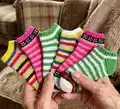
๐Ÿงถ Beautiful โœจ Detailed ๐Ÿ’ Adorable

Folk Flower Socks Pattern

Folk Flower Socks Pattern
4.0โ˜… Rating
5-7 Hours Time Needed
4.1K Made This
โœ‚๏ธ

Intermediate Level

Ideal for those with basic crochet experience, featuring slightly more advanced stitches and techniques to expand your skills.

โฑ๏ธ

Weekend Treat

Takes 5-7 hours, making it an enjoyable project to finish over a couple of days.

๐ŸŽ€

Playful Twist

Fun patterns meet timeless design in pieces that express personality while remaining wonderfully wearable.

About This Folk Flower Socks Pattern

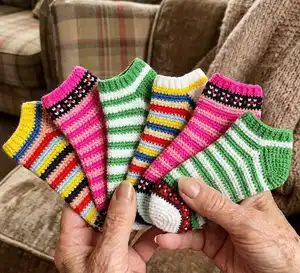
This pattern teaches you how to knit ankle and calf-length Folk Flower socks with a small charted colorwork band and bold stripes. It includes instructions for two-size groups and options for shorty or calf-length styles. Youll learn heel flap and turn shaping, gusset decreases, and Kitchener grafting for the toe.

Folk Flower Socks Pattern crochet pattern - detailed view of completed project

Worked in Lang Jawoll fingering-weight yarn (75% superwash wool/25% nylon), the pattern uses 5-round stripes and a 9-round colorwork chart. Detailed notes on needles, color placement, and stripe management are included.

Why You'll Love This Folk Flower Socks Pattern

I absolutely love this pattern because it combines bright, playful stripes with a small, vintage-inspired colorwork band that adds personality without overwhelming the sock. I enjoy the clever use of short stripe repeats โ€” they make color changes quick and satisfying. The heel flap and gusset shaping create a snug, comfortable fit that actually stays on your foot. I also love how adaptable the pattern is: you can make ankle socks or calf-length versions with just a few yarn and needle adjustments.

Folk Flower Socks Pattern step 1 - construction progress Folk Flower Socks Pattern step 2 - assembly progress Folk Flower Socks Pattern step 3 - details and accessories Folk Flower Socks Pattern step 4 - final assembly and finishing

Switch Things Up

I love customizing these socks by switching the stripe colors for a totally different vibe; try pastel shades for a soft, vintage look or neon brights for a modern pop.

You can easily make the socks larger or smaller by changing yarn weight and needle size โ€” bulky yarn plus larger needles gives you chunky cozy socks while thinner yarn yields mini keychain-sized versions.

I often change the colorwork motif colors for more contrast; using a brighter CC for the flower motif really makes it sing against a dark MC background.

For an alternative cuff, try a longer 2x2 or a folded hem instead of the short rib to add a little warmth and structure around the ankle.

If you want a more durable heel, try a slipped-stitch honeycomb or reinforced heel technique while keeping the rest of the sock pattern the same.

I sometimes knit the colorwork chart at the toe instead of the cuff for a surprise detail; just reposition the colors and keep the same number of rounds for balance.

To make a matching set, use the same MC with different CCs for each pair so the family set reads as coordinated but not identical.

Try stranded colorwork for the band if you want a slightly thicker, warmer motif โ€” be mindful of floats and tension across the back of the work.

If you want posable or more structured socks for display, use a slightly smaller needle for the heel flap and gusset to tighten the fabric without changing overall gauge significantly.

I also like to embroider small initials or hearts near the cuff after blocking for a personal touch that makes each pair a special gift.

Common Mistakes & How to Fix Them

โœ— Not checking your gauge before starting can result in socks that are too small or too large; always knit a gauge swatch in stockinette and block it to match the stated gauge before beginning. โœ— Cutting yarn at every stripe change creates many ends to weave in later; instead carry the unused color on the inside of the work for five-round stripes to minimize ends and tidy floats. โœ— Working the heel flap too loosely will cause a floppy heel that does not cup the foot properly; maintain even tension and use the slipped-stitch pattern instructions for a dense, durable flap. โœ— Skipping stitch markers when joining or placing gusset markers causes confusion during decreases; place markers at the start of round and at gusset join points to keep track of shaping accurately.

Folk Flower Socks Pattern

Make bright, playful Folk Flower socks with colorful stripes and a charming floral colorwork band. This pattern guides you through cuff-to-toe sock construction, including heel flap and turn, gusset shaping, and toe closure. Youll enjoy working the 5-round stripe repeats and the small charted colorwork motif for a vintage-folk look. Suitable for knitters who like color changes and precise shaping.

Intermediate 5-7 Hours

Materials Needed for Folk Flower Socks Pattern

โ€” Main Fabric

  • 01
    Yarn (Green Shorties) MC: Lang Jawoll [75% superwash wool, 25% nylon; 230 yards (210 m) / 50 g (1.7 oz)]: (56) 67 (80, 94, 108) yards / (51) 61 (73, 86, 99) meters in "118 Green."
  • 02
    Yarn (Green Shorties) CC1: Lang Jawoll [75% superwash wool, 25% nylon; 230 yards (210 m) / 50 g (1.7 oz)]: (48) 59 (68, 77, 92) yards / (44) 54 (62, 70, 84) meters in "373 Mint."
  • 03
    Yarn (Green Shorties) CC2: Lang Jawoll [75% superwash wool, 25% nylon; 230 yards (210 m) / 50 g (1.7 oz)]: (10) 12 (14, 16, 18) yards / (9) 11 (13, 15, 16) meters in "4 Black."
  • 04
    Yarn (Green Shorties) CC3: Lang Jawoll [75% superwash wool, 25% nylon; 230 yards (210 m) / 50 g (1.7 oz)]: (9) 11 (13, 15, 17) yards / (8) 10 (12, 14, 15) meters in "94 Pearl."
  • 05
    Yarn (Green Shorties) CC4: Lang Jawoll [75% superwash wool, 25% nylon; 230 yards (210 m) / 50 g (1.7 oz)]: (2) 2 (2, 2, 3) yards / (2) 2 (2, 2, 3) meters in "60 Crimson."
  • 06
    Yarn (Multi-color Shorties) MC: Lang Jawoll [75% superwash wool, 25% nylon; 230 yards (210 m) / 50 g (1.7 oz)]: (16) 19 (24, 28, 34) yards / (15) 17 (22, 26, 31) meters in "94 Pearl."
  • 07
    Yarn (Multi-color Shorties) CC1: Lang Jawoll: (18) 22 (26, 30, 34) yards / (16) 20 (24, 27, 31) meters in "149 Pineapple."
  • 08
    Yarn (Multi-color Shorties) CC2: Lang Jawoll: (22) 26 (30, 34, 38) yards / (20) 24 (27, 31, 35) meters in "4 Black."
  • 09
    Yarn (Multi-color Shorties) CC3: Lang Jawoll: (18) 22 (26, 30, 34) yards / (16) 20 (24, 27, 31) meters in "109 Pink."
  • 10
    Yarn (Multi-color Shorties) CC4: Lang Jawoll: (18) 22 (26, 30, 34) yards / (16) 20 (24, 27, 31) meters in "60 Crimson."
  • 11
    Yarn (Multi-color Shorties) CC5: Lang Jawoll: (18) 22 (26, 30, 34) yards / (16) 20 (24, 27, 31) meters in "220 Something Blue."
  • 12
    Yarn (Pink Calf-length) MC: Lang Jawoll [75% superwash wool, 25% nylon; 230 yards (210 m) / 50 g (1.7 oz)]: (68) 77 (94, 112, 126) yards / (62) 70 (86, 102, 115) meters in "184 Hot Pink."
  • 13
    Yarn (Pink Calf-length) CC1: Lang Jawoll [75% superwash wool, 25% nylon; 230 yards (210 m) / 50 g (1.7 oz)]: (62) 71 (86, 103, 114) yards / (57) 65 (79, 94, 104) meters in "129 Melon."

โ€” Tools Required

  • 01
    US size 1 (2.25 mm) needles (DPNS or 9" short circular) - main needle for socks
  • 02
    US size 2 (2.75 mm) needle (optional) for colorwork band at cuff if you want a slightly looser band
  • 03
    Magic loop method (optional) or 9" short circular to knit colorwork bands
  • 04
    Tapestry needle for weaving in ends
  • 05
    Stitch markers
  • 06
    Snips / small scissors
  • 07
    Measuring tape
  • 08
    Pins for blocking (optional)

Progress Tracker

0% Complete

โ€” Tips :

Info :

Stripe Pattern: 5 rnds of each color

Info :

Two-color stripes: There's no need to cut your yarn between stripe bands! These socks call for 5-round stripes: simply carry the yarn you aren't using on the inside of your work, then pick it up again when you need it!

Info :

Multi-color stripes: Are you worried about weaving in allllll those ends? Don't fret! There's a simple trick to knitting your ends in as you go. Click this LINK to watch a video tutorial of the technique I use!

Info :

Avoiding a jog when you switch colors: Did you know you are technically knitting a spiral when you knit in the round? This causes a jog when you switch colors. The first stitch in your new color will sit up higher than the last stitch in the previous round that you knit in your old color. There's a simple trick to hide this jog! Knit the first round in your new color. On the first stitch of the second round, use your right needle to pick up the right leg of the stitch just below that first stitch and place it on your left needle. Then knit that leg together with the first stitch. Easy! Continue on knitting the rest of the rounds in that stripe like normal.

โ€” Cuff :

Info :

With MC, CO (48) 57 (63, 72, 81) sts and join for working in the rnd, being careful not to twist your sts. Est 2 x 1 ribbing: [k2, p1] to end.

Info :

Cont working the ribbing until your cuff measures 3/4" (2 cm), or your desired length. On the last rnd of the ribbing, some of you need to adjust your stitch count. If you are working the Kid size, or L, move on to the leg instructions. The rest of you, make the following increase or decrease according to your size:

Info :

S: Work in rib pattern to the last 3 sts, k2tog, p1. 56 sts.

Info :

M: Work in rib pattern to the last 3 sts, kfb, k1, p1. 64 sts.

Info :

XL: Work in rib pattern to the last 3 sts, k2tog, p1. 80 sts.

โ€” Leg (Shorty Version) :

Info :

*Note: If you are knitting the two-color stripes, or the multi-color stripes, don't cut your MC. Simply join in your CC and carry your MC on the inside of your work.

Round 1 :

Join in CC1 and work one stripe (5 rnds) even in stockinette.

โ€” Leg (Calf-length Version) :

Info :

Cut MC and join in CC2. Work all 9 rnds of the chart once. Cut CC2, CC3, and CC4. Join in CC1. Begin working stripe pattern in stockinette, alternating between CC1 and MC, until your leg (including cuff!) measures 3" / 8 cm, or your desired length. I worked 5 stripes total before stopping for the heel! End after working a CC1 stripe.

โ€” Heel Flap :

Info :

With MC, knit 1 rnd even. Next, K across the first (24) 28 (32, 36, 40) sts, then begin working the heel flap back and forth across the remaining (24) 28 (32, 36, 40) sts as follows:

Row 1 (RS) :

K2, [sl 1 wyib, k1] to end. Turn work.

Row 2 (WS) :

Sl 1 wyif, p to end. Turn work.

Row 3 :

[Sl 1 wyib, k1] to end. Turn work.

Info :

Repeat rows 2 and 3 until heel flap measures (1.75) 2 (2, 2.25, 2.5)" / (4.5) 5 (5, 5, 6) cm. End after you have worked row 3.

โ€” Heel Turn :

Row 1 (WS) :

Sl 1 wyif, p (12) 14 (16, 18, 20), p2tog, p1, turn.

Row 2 (RS) :

Sl 1 wyib, k3, ssk, k1, turn.

Row 3 :

Sl 1 wyif, p4, p2tog, p1, turn.

Row 4 :

Sl 1 wyib, k5, ssk, k1, turn.

Info :

You have now established the following pattern for your heel turn: sl 1, knit or purl to 1 st before the gap created by turning on the previous row, ssk or p2tog, k1 or p1, turn. Cont in this pattern until all your heel sts have been worked, ending on a RS row. You should now have (14) 16 (18, 20, 22) heel sts.

โ€” Gusset :

Info :

*Note: If you are working multi-color socks, you will cut MC, and join in your next color before picking up your stitches! For two-color striped socks, you will cont working the gusset in MC.

Info :

With the right side of your work facing, pick up and k (10) 12 (14, 16, 18) sts along the left side of the heel flap. Next, k across the (24) 28 (32, 36, 40) sts that we've left undisturbed on our needles while working the heel flap. Pm, and pick up (10) 12 (14, 16, 18) sts on the right side of the heel flap. K across the heel sts, then k down the first set of new sts you picked up on the left side. You've reached the end of the rnd, and all your sts have now been picked up. You should now have (58) 68 (78, 88, 98) sts on your needles. You will also have completed 2 rnds of a stripe (you knit the first rnd of the stripe before you worked the heel flap!).

โ€” Gusset Decreases :

Rnd 1 :

K across (24) 28 (32, 36, 40) sts, sl marker, k1, ssk, k around to 3 sts before the end of rnd, k2tog, k1.

Rnd 2 :

Work even with no decreases.

Info :

Repeat these two rnds until you have (48) 56 (64, 72, 80) sts on your needles, while at the same time working the 5 rnd stripe pattern.

โ€” Foot :

Info :

Cont working in stripe pattern until your foot measures 3/4" / 2 cm SHORT of where you need to stop for the toe decreases. To figure that out, we need to do some quick (and easy!) math. First, let's determine how long the foot of your sock needs to be. The Craft Yarn Council has issued the following length guidelines for the foot of a sock, measured from the back of the heel to the end of the toe. (All sizes are US) Kid: 6 - 7.5" / 11 - 15 cm Women's shoe sizes 4 - 6.5: 8 - 9" / 20.5 - 23 cm Women's shoe sizes 7 - 9.5: 9.25" - 10" / 23 - 25.5 cm Women's shoe sizes 10 - 12.5: 10.25 - 11" / 26 - 28 cm Men's shoe sizes 6 - 8.5: 9.25 - 10" / 23 - 25.5 cm Men's shoe sizes 9 - 11.5: 10.25 - 11" / 26 - 28 cm Men's shoe sizes 12 - 14: 11.25 - 12" / 28.5 - 30.5 cm

Info :

Your approximate toe length (once you've eventually knit it) should be: Kid: 1" / 2.5 cm S: 1.5" / 4 cm M: 1.5" / 4 cm L: 1.5" / 4 cm XL: 1.75" / 4 cm

Info :

Now, join in your first CC and work all 9 rnds of the chart once. Join in your toe color and k 1 rnd even in stockinette.

โ€” Toe :

Rnd 1 :

K1, ssk, k (18) 22 (26, 30, 34) sts, k2tog, k1, pm, k1, ssk, k (18) 22 (26, 30, 34) sts, k2tog, k1. 4 sts decreased.

Rnd 2 :

K.

Rnd 3 :

K1, ssk, k to 3 sts before next marker, k2tog, k1, sl m, k1, ssk, k around to 3 sts before end of rnd, k2tog, k1. 4 sts decreased.

Info :

Repeat rnds 2 and 3 until (20) 24 (28, 32, 36) sts remain.

Info :

Use Kitchener Stitch to close the toe.

โ€” Finishing :

Info :

Weave in all ends and block your socks!

Assembly Instructions

  • Use Kitchener Stitch to graft the final remaining toe sts together for a neat, comfortable finish.
  • Weave in all yarn ends securely on the inside of the sock and trim excess yarn closely for a tidy look.
  • Block your socks gently to even out the fabric and set the stitches; pin into shape and steam or wet-block as appropriate for your yarn.
  • When placing the gusset and picking up sts for the instep, place markers at each junction to ensure symmetry before beginning gusset decreases.
  • If you carried colors for stripes, tuck and tidy floats on the inside as you go to avoid long loose strands that can catch on things.

Important Notes

  • ๐Ÿ’กUse stitch markers to keep track of your rounds and the start of the gusset decreases to avoid mistakes during shaping.
  • ๐Ÿ’กIf knitting the calf-length socks with the colorwork band near the cuff, consider switching to a slightly larger needle for the band if you have tight tension.
  • ๐Ÿ’กFor 5-round stripes you do not need to cut yarn between stripes; carry the unused yarn on the inside and pick it up again to reduce ends.
  • ๐Ÿ’กWork heel flap slipped-stitch pattern with consistent tension for durability and a good fit; check length measurement frequently during the flap and foot.

Thank you so much for supporting this pattern โ€” happy knitting and bright socks ahead! ๐Ÿงถ These Folk Flower socks were designed to be playful, wearable, and easy to personalize with color choices. Try different stripe combinations or swap yarns to make a set uniquely yours. ๐Ÿงตโœจ

You ask,

we answer.

FAQs

What size will the finished piece be?

The finished sock size depends on which stitch count you choose; the pattern provides stitch counts and measurements for Kid, S, M, L, and XL. Gauge is 38 sts = 4" / 10 cm in stockinette in the round, and the final fit will depend on your gauge and yarn.

Can I use different yarn weights for this pattern?

You can use different yarn weights, but this will change the final size and drape of the socks. The pattern is written for fingering-weight Lang Jawoll; if you change yarn weight, adjust needle size and re-check gauge.

Do I need prior knitting experience for this pattern?

This pattern is rated intermediate because it includes colorwork, heel flap and turn shaping, gusset decreases, and Kitchener grafting. Familiarity with knitting in the round, slipped-stitch heel flaps, and basic decreases is recommended.

How long does this project typically take to complete?

Most knitters finish a pair of ankle socks in about 5-7 hours, depending on your speed, familiarity with techniques, and whether you are making calf-length versions.