🧢 Beautiful ✨ Detailed πŸ’ Adorable

Floral Crochet Bouquet Pattern

Floral Crochet Bouquet Pattern
4.2β˜… Rating
5-7 Hours Time Needed
1.3K Made This
βœ‚οΈ

Intermediate Level

Ideal for those with basic crochet experience, featuring slightly more advanced stitches and techniques to expand your skills.

⏱️

Weekend Treat

Takes 5-7 hours, making it an enjoyable project to finish over a couple of days.

🌸

Cozy Accent

A warm touch for your space that transforms ordinary corners into inviting nooks filled with handmade charm.

About This Floral Crochet Bouquet Pattern

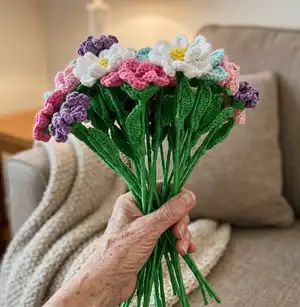
This pattern teaches you how to crochet a full bouquet made from cotton yarn: roses, daisies, five-petal flowers, buds, sepals and leaves. You will learn how to create neat stems using floral wire and glue for a sturdy, realistic result. Photo steps and charts are included to help you visualize each stitch and shape.

Floral Crochet Bouquet Pattern crochet pattern - detailed view of completed project

Detailed instructions for each element (leaf, sepal, central flower part, petals) are given with chart diagrams. The techniques are adaptable to different yarn thickness and hook sizes for varied finished sizes.

Why You'll Love This Floral Crochet Bouquet Pattern

I absolutely love this pattern because it turns simple crochet stitches into elegant, lasting flowers you can display all year round. I love the way the small motifs build into a full bouquet β€” it feels rewarding to see incremental progress become a beautiful arrangement. The method for wrapping stems and attaching sepals and leaves gives a polished finish that I always enjoy. I also enjoy experimenting with colors and yarn counts to create different looks from delicate mini blooms to fuller statement flowers.

Floral Crochet Bouquet Pattern step 1 - construction progress Floral Crochet Bouquet Pattern step 2 - assembly progress Floral Crochet Bouquet Pattern step 3 - details and accessories Floral Crochet Bouquet Pattern step 4 - final assembly and finishing

Switch Things Up

I love how versatile this pattern is for customization! You can switch colors to make seasonal bouquets β€” pastels for spring, deep tones for autumn, or holiday shades for gift-making.

Want a larger statement bouquet? Use thicker yarn or double up threads and increase your hook size to make each flower fuller and more dramatic.

To make tiny charms or keychains, use superfine yarn and a much smaller hook to create miniatures from the same patternβ€”perfect for gifts and ornaments.

I often add embroidered veins on leaves or tiny bead centers to daisies to add sparkle and texture to the flowers for a more crafted finish.

Try different stem finishes: wrap with floral tape for a garden-shop look or use brown thread for rustic stems; you can even braid several wires together for extra strength in large bouquets.

Change the number of petals or repeat rows for petals to alter the fullness of roses and carnations β€” more repeating rows equals fuller petals and a ruffled effect.

Make mixed bouquets by combining several flower types (roses, daisies, small five-petal flowers) and vary stem lengths for natural-looking arrangements.

If you like posable stems, insert a thin gauge wire inside a thicker wire or use floral wire coated with green tape to make stems flexible but stable.

I also enjoy making matching sets of leaves and sepals in contrasting shades of green for depth β€” try a darker green base with a lighter green overlay for realism.

Finally, don't be afraid to combine yarn textures β€” a mix of cotton and a slightly silky thread can make petals gleam and add a lux finish to a special bouquet.

Common Mistakes & How to Fix Them

βœ— Not fixing the yarn end firmly to the wire before winding; glue the yarn end and secure it before winding to prevent slippage. βœ— Skipping counting chains and stitches in the rose or daisy rows can lead to uneven petals; count each chain and stitch at the end of each row before continuing. βœ— Using too thin or too thick floral wire for the chosen yarn thickness may distort the flower balance; choose wire thickness according to the flower volume and test with one stem first. βœ— Applying too much glue when winding the stem will stiffen the ribbon and make it look bulky; apply glue gradually and wind tightly to keep the stem smooth. βœ— Not ironing cotton leaves when using cotton yarn can leave them floppy; if using cotton yarn, lightly iron the leaf to shape and make it hold form. βœ— Failing to pin parts in place before gluing or sewing can result in asymmetry; always position and check parts before final attachment.

Floral Crochet Bouquet Pattern

Make a beautiful everlasting bouquet using simple crochet motifs β€” roses, daisies, blue flowers, buds and carnations. This pattern walks you through petals, sepals, leaves and stems with clear photo-assisted instructions so you can create a full 25-flower bouquet. Perfect for gifts and home decor, you will learn finishing and assembly techniques to make professional-looking stems and secure petals.

Intermediate 5-7 Hours

Materials Needed for Floral Crochet Bouquet Pattern

β€” Main Fabric

  • 01
    YarnArt Begonia cotton yarn 169m/50g - green for leaves, stems and sepals (quantity depends on bouquet size)
  • 02
    Bright pink yarn - for roses (approx. 50g for 5 roses)
  • 03
    White and yellow yarn - for daisies (white for petals, yellow for centers)
  • 04
    Two shades of blue yarn - for blue flowers (small amounts of each)
  • 05
    Soft pink yarn - for buds (small amounts)
  • 06
    Purple yarn - for carnations/cloves (small amounts)
  • 07
    Small amount of yellow for the central part of some flowers

β€” Tools Required

  • 01
    Crochet hook size 2.0 mm (2 mm hook used in the photos)
  • 02
    Scissors
  • 03
    Yarn needle for sewing and weaving ends
  • 04
    Stitch markers (optional)
  • 05
    Polyester stuffing (not used for flowers but for some variations)
  • 06
    Floral wire 1.1 mm thick, 10 inch (25 cm) long for stems (0.8-0.9 mm can also be used)
  • 07
    Measuring tape
  • 08
    Pliers to cut floral wire
  • 09
    Silicone glue or hobby glue
  • 10
    Small iron (for ironing cotton leaves or sepals)
  • 11
    Pins for assembly

Progress Tracker

0% Complete

β€” General Info :

Info :

The bouquet includes 25 flowers: 5 roses, 5 daisies, 5 blue flowers, 5 buds and 5 carnations. Colors used: for leaves, stems and sepals - green. For roses - bright pink. For daisies - white and yellow. For blue flowers - two shades of blue. For buds - soft pink. For cloves (carnations) - purple.

Info :

Necessary materials: yarn (two colors are used for photo tutorial - yellow and green). hook, scissors, a needle, floral wire, measuring tape, pliers, glue.

Info :

This bouquet is made of cotton yarn, brand YarnArt "Begonia" 169m/50g. The hook used is 2 mm in size. Stems 10 inches (25 cm) tall. Flowers size 1.7 inches (4.5 cm) to 2.3 inches (6 cm). If yarn is thin (e.g., No.10), flowers will be smaller; use two strands for larger leaves.

β€” Stem :

Info :

I will make each flower 25 cm (10 inches) long. The length of the stem is selected according to the size of the flowers that will be planted on the stem. If the flowers are small, a stem length of 25 cm (10 inches) is fine, my flower heads are between 6 cm (2.3 inches). If the volume of your flowers is larger, you can make the stem length 30 cm (12 inches). Using pliers, cut the required length of wire for the stem.

Info :

Apply glue to the edge of the wire and fasten the yarn firmly. Gradually apply glue to the wire and wind the yarn. Firmly fix the yarn on the edge of the wire, cut the yarn and continue winding until the entire wire is covered.

β€” Leaf :

Row 1 :

CH 7.

Row 2 :

CH 1, SC 1 in the first chain (I perform the second row in the back side of the chains, it's just more convenient for me, you perform as convenient for you).

Row 2 Detail :

HDC 1 in the second chain. DC 1 in the third chain. DC 2 in the fourth chain. TR 2 in the fifth chain. DTR 3 in the sixth chain. DTR 7 in the seventh chain.

Row 2 Continued :

Then we perform stitches in the same chains, according to the stitches that have already been made so the edge of the yarn that sticks out can be pressed to each subsequent chain, so it will be fixed and add solid to the middle part of the leaf.

Row 3 :

DC 1 in the same chain where DC 1 have already been made, HDC 1 in the next chain, SC 1 in last chain. CH 1. ST in the first SC of this row.

Row 4 :

DTR 3 in the same chain where DTR 3 have already been made. TR 2 in the same chain where TR 2 have already been made. DC 2 in the same chain where DC 2 have already been made.

Row 5 :

SC 1 in the first DC of three, SC 1 in the second DC, SC 1 in the third DC, SC 1 in the first TR of two, SC 1 in the second TR. SC 2 in the first DTR of thirteen. SC 2 in the second DTR, SC 2 in the third DTR, SC 2 in the fourth DTR, SC 2 in the fifth DTR. SC 3 in the sixth DTR. SC 1 in the seventh DTR. CH 2.

Row 6 :

SC 1 in the seventh DTR. SC 3 in the eighth DTR. SC 2 in the ninth DTR. SC 2 in the tenth DTR, SC 2 the eleventh DTR, SC 2 in the twelfth DTR, SC 2 in the thirteenth DTR.

Row 7 :

SC 1 in the first TR of two, SC 1 in the second TR, SC 1 in the first DC of two, SC 1 in the second DC, and repeat SC 1 in the next each stitches. CH 2.

Row 8 :

ST in the first SC of this row. Done. Fasten and trim the ends of the yarn. (The same leaves are made for each type of flower.) If cotton yarn is used, the leaf can be easily ironed.

β€” Sepal :

Row 1 :

Magic ring. CH 1, SC 14 in the magic ring. Tighten the magic ring, ST in the first SC of this row.

Row 2 :

DC 1 in the first SC. Repeat DC 2 in each SC as shown in chart. ST in the third chain.

Row 3 :

CH 4. TR 3-cluster in the next DC 3. CH 4. ST in the next DC. Repeat to make 5 more of the same leaves. ST in the beginning of this row. Done. Fasten and trim the ends of the yarn. (Check whether the size of the hole of the sepal is suitable for the thickness of the stem, if not, then adjust the magic ring.)

β€” Rose (chart and photo steps) :

CH 41 :

Work row foundation CH 41. (Chart for Rose shows petals created along long chain.)

Row 1 :

CH 2, HDC 1 in the second chain, HDC 1 in the fourth chain, HDC 1 in the fifth chain β€” continue repeating HDC in each chain until end of row. (Second row performed in back side of chains is optional for preference.)

Row 2 - Row 3 :

Follow the rose chart: create clusters and fans along chain to create petals and then roll the strip to form the rose center. Use glue at base to hold shape and wind around the stem. Finish by securing the strip and hiding ends inside formed rose.

β€” Leaf (chart for leaf) :

Info :

Follow the chart for a leaf shown on the diagrams. The photo steps described earlier provide a step-by-step visual for chain, hdc, dc, tr, dtr increases to create the scalloped leaf shape.

β€” Flower (five petal small) :

Row 1 :

Magic ring. CH 1, SC 10 in the magic ring. Tighten the magic ring, ST in the first SC of this row.

Row 2 :

CH 3 from the first SC. TR 2 in the second SC. CH 2. (Repeat to create arches for petals along ring). Continue until you create the required number of petals (basic photo instructions: TR 2, CH 2, TR 2 in next SC). Make 5 petals in the first layer.

Row 3 (second layer) :

Start the second layer of petals by making arches under first layer arches: CH 4, pull the yarn through the 3rd SC of previous row to the other side, make arches and form second layer over the first, filling petals as shown on photos. ST in the beginning of this row. Fasten and trim the edges of the yarn. Done.

β€” Flower central part :

Row 1 :

Magic ring. CH 1, SC 6 in the magic ring. Tighten the magic ring and ST in the first SC of this row.

Row 2 :

CH 1. SC 2 in the first SC, repeat SC 2 in each SC across to enlarge central disk (SC 12). This central part can be used as the center for daisies or other layered flowers.

β€” Rose assembly :

Info :

Determine the edge of the wire where the yarn began to be wound (usually this edge looks worse than the edge where the thread ended). It is on this edge that I recommend winding the rose. Apply glue to the first petal and on the areas shown in photos, then gradually wind the ribbon on the stem, apply glue and wind further. With the side where the edges of the yarn are fast, put the sepal on the stem, apply glue and stick to the flower. Apply glue to the narrow edge of the leaf and glue to the stem.

Info :

Then gradually wind the ribbon on the stem, apply glue and wind further. Check whether the size of the hole of the flower is suitable for the thickness of the stem. If not, expand or tighten the magic ring. Fasten and trim yarn ends after assembly. Done.

β€” Flower (rose / daisy / carnation finishing notes) :

Info :

Make roses in the colors you like; for my bouquet I made 5 pink roses. For daisies use white petals and yellow central disk; for carnations use repeated small rippled petals. Glue and assembly photos show the process of attaching sepals, gluing petals and securing to stems.

Assembly Instructions

  • Wrap the floral wire with yarn: apply glue to the wire tip, secure the yarn end and wind tightly until the entire wire is covered; trim and glue the end so the stem is smooth.
  • Wind the rose strip around the prepared stem starting from the rougher edge, applying a little glue to the base of each petal area and pressing petals to hold the spiral in place.
  • Attach the sepal: place sepal over the stem under the flower head, apply glue to the sepal hole edge and press to the underside of the flower to hide the stem base.
  • Glue and position leaves: apply glue to the narrow edge of each leaf and attach to the stem a short distance below the sepal, pressing firmly until fixed.
  • For daisies and small flowers, insert the central disk into the flower center (if applicable) and secure with glue before attaching to stem; then cover joint with sepal and press.
  • Pin parts in place before final gluing to make sure of symmetry and trim any excess yarn ends neatly after glue dries.

Important Notes

  • πŸ’‘Choose floral wire thickness appropriate to your yarn; thicker flower heads need thicker wire for balance.
  • πŸ’‘Always test the size of the sepal hole with your chosen stem before final winding; adjust the magic ring if the hole is too small or large.
  • πŸ’‘Apply glue sparingly and in stages when wrapping stems to avoid bulky or stiff spots; let glue tack before continuing to wind.

This crochet bouquet pattern combines delicate stitches with smart finishing touches to create lasting handmade flowers. Make a set of roses, daisies and buds in your favorite colors to brighten any room. Perfect for gifts, decor, or a relaxing weekend make. 🌸🧢

You ask,

we answer.

FAQs

What size will the finished piece be?

Each stem is about 25 cm (10 inches) tall by default; flower head diameters range from about 4.5 cm to 6 cm depending on yarn and hook size.

Can I use different yarn weights for this pattern?

Yes, you can use different yarn weights but the final size will change; for larger flowers choose thicker yarn or use two strands, and adjust the floral wire thickness accordingly.

Do I need prior crochet experience for this pattern?

This pattern is rated intermediate; basic knowledge of single crochet, double crochet, treble and reading simple charts is recommended for best results.

How long does this project typically take to complete?

Most crocheters complete a full bouquet of 25 flowers in about 5-7 hours total, though time may vary based on experience and assembly preferences.

What glue is recommended for attaching parts?

Silicone glue, universal hobby glue or a clear craft adhesive are suitable for gluing parts on these crochet flowers.