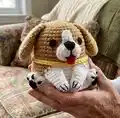
🧢 Beautiful ✨ Detailed πŸ’ Adorable

Dog Amigurumi Pattern

Dog Amigurumi Pattern
4.1β˜… Rating
5-7 Hours Time Needed
1.5K Made This
βœ‚οΈ

Intermediate Level

Ideal for those with basic crochet experience, featuring slightly more advanced stitches and techniques to expand your skills.

⏱️

Weekend Treat

Takes 5-7 hours, making it an enjoyable project to finish over a couple of days.

🧸

Cute Companion

An adorable friend to cherish, handcrafted with love to bring comfort and joy for years to come.

About This Dog Amigurumi Pattern

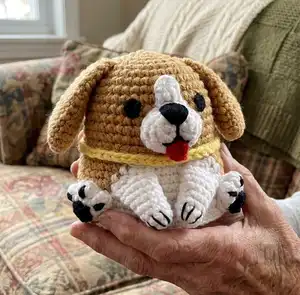
This pattern creates a small dog amigurumi with a rounded body, floppy ears, a bowl-shaped muzzle and tiny paws. It includes instructions for color changes, bobble stitches and surface slip stitch decoration. The pattern is written in US crochet terms and uses continuous spiral rounds where specified.

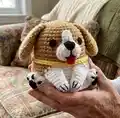
Dog Amigurumi Pattern crochet pattern - detailed view of completed project

You will make separate pieces (head/body, ears, muzzle, legs, paws, tail) and assemble them using the provided placement notes. Special stitch instructions and finishing tips are included to help you get a neat, professional result.

Why You'll Love This Dog Amigurumi Pattern

I absolutely love this pattern because it turns simple stitches into a character full of personality with minimal materials. I enjoy how the color changes and bobble paws add charming details that really bring the dog to life. The shaping is thoughtful and makes assembly straightforward, which I find very satisfying. I also appreciate that the pattern is adaptable β€” small color swaps create many different dog breeds with the same instructions.

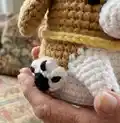
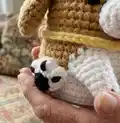
Dog Amigurumi Pattern step 1 - construction progress Dog Amigurumi Pattern step 2 - assembly progress Dog Amigurumi Pattern step 3 - details and accessories Dog Amigurumi Pattern step 4 - final assembly and finishing

Switch Things Up

I love how easy it is to customize this pattern; change the main color to create different dog breeds and personalities.

Try using pastel yarns for a soft, nursery-friendly version or bold brights for a playful lookβ€”your color choices change the whole mood.

To change the size, use a different yarn weight and a larger or smaller hook: bulky yarn will give you a chunky cuddly toy, while fingering weight creates tiny keychain friends.

I often add embroidered eyebrows or different eye shapes to alter expressionβ€”moving the eyes even one or two stitches makes a big difference.

Swap the bobble paws for flat pads by reducing the bobble stitch count for a sleeker look if you prefer minimal texture.

Try a reversible pair by crocheting two dogs and joining them with the long starting tails to create double-sided play buddiesβ€”it's a fun challenge!

For a sturdier base, inset a cardboard or thin plastic circle before sewing the base on so the toy stands neatly on display.

I sometimes add tiny accessories like a crocheted scarf, collar charms, or little hats to give each dog a signature look.

Experiment with surface slip stitches to add stripes, spots or collar details; they are quick to work and make a big visual impact.

If you want posable limbs, consider inserting thin wire inside the legs before stuffing, or make removable outfits to dress your amigurumi for play.

Common Mistakes & How to Fix Them

βœ— Skipping stitch markers at the beginning of each round causes you to lose track of round starts; place a marker and move it every round to maintain your place. βœ— Changing colors by carrying yarn too tightly will pucker the fabric and distort shaping; cut and join new colors or carry loosely and block gently if necessary. βœ— Forgetting to stuff gradually results in lumps or flattened shapes; add small amounts of fiberfill as you go to maintain even shaping and control. βœ— Not flattening and working through both loops when instructed will prevent proper shaping of flat parts like paws and muzzles; follow the instruction to flatten and work through both loops at the last rounds. βœ— Ignoring the invisible finish method can leave a visible tail or gap; use the invisible finish technique described to draw the tail and close the work neatly.

Dog Amigurumi Pattern

Create a charming handcrafted dog amigurumi with detailed step-by-step instructions. This pattern walks you through the head, body, ears, muzzle, legs, paws, tail and finishing touches so you can build a lovable plushie. It includes clear rounds, color-change notes, special stitch tips and assembly guidance so you can follow along with confidence. Perfect for crafters who enjoy small, detailed amigurumi projects.

Intermediate 5-7 Hours

Materials Needed for Dog Amigurumi Pattern

β€” Main Fabric

  • 01
    4 ply cotton blend yarn (approx 10-50g per color depending on variant)
  • 02
    Beagle colors: brown (main), white (belly/muzzle/paws), black (spots/tail tip), yellow (collar), red (tongue), peach (small accents) - small amounts each (~10-30g)
  • 03
    Dalmatian colors: white (main), black (spots/ears/paws), blue (collar), peach (paw pads), red (tongue) - small amounts each (~10-30g)
  • 04
    Pug colors: light beige (main), dark brown (muzzle/ears/marks), orange (collar), peach (paw pads), black (eye/nose/mouth) - small amounts each (~10-30g)
  • 05
    Extra small amounts of contrast colors for details (tongue, paw pads, collar) about 5-15g each

β€” Tools Required

  • 01
    Crochet hook size 2.0 mm (or size suitable for the yarn used)
  • 02
    Tapestry needle and embroidery needle
  • 03
    Scissors
  • 04
    Stitch markers
  • 05
    Fiberfill for stuffing
  • 06
    Small piece of cardboard or rigid plastic for the base (optional)

Progress Tracker

0% Complete

β€” Head and Body :

Info :

Start with brown yarn. Leave a long starting yarn tail, approximately 10 cm (4"). This tail will be used to join 2 dogs to make a reversible amigurumi.

Round 1 :

6sc in MR (6)

Round 2 :

6inc (12)

Round 3 :

[sc, inc]x6 (18)

Round 4 :

[sc, inc, sc]x6 (24)

Round 5 :

[3sc, inc]x6 (30)

Round 6 :

[2sc, inc, 2sc]x6 (36)

Round 7 :

[5sc, inc]x6 (42)

Round 8 :

42sc (42)

Round 9 :

[3sc, inc, 3sc]x6 (48)

Round 10-13 :

48sc (48)

Round 14 :

[7sc, inc]x6 (54)

Info :

Starting from R15, we will crochet using black, brown, and white yarn alternately. To simplify the writing, black, brown, and white color of the font below corresponds to the yarn colors. Important tips: when doing color changes in reversible amigurumi, it is recommended to cut and start with a new yarn every time you change the yarn color.

Round 15 :

BLO 5sc, 17sc, 10sc, 17sc, 5sc (54)

Round 16 :

6sc, 15sc, 12sc, 15sc, 6sc (54)

Round 17-18 :

7sc, 13sc, 14sc, 13sc, 7sc (54)

Round 19 :

8sc, 11sc, 16sc, 11sc, 8sc (54)

Round 20 :

4sc, inc, 3sc, 5sc, inc, 5sc, 3sc, inc, 8sc, inc, 3sc, 5sc, inc, 5sc, 3sc, inc, 4sc (60)

Round 21-22 :

10sc, 11sc, 18sc, 11sc, 10sc (60)

Info :

Fasten off, cut the yarn and do invisible finish.

β€” Head and Body (Alternate white/light beige start) :

Info :

Alternate version shown for other dog variants. Start with white (or light beige) yarn. Leave a long starting tail approximately 10 cm (4"). This tail may be used to join two toys if making a reversible toy.

Round 1 :

6sc in MR (6)

Round 2 :

6inc (12)

Round 3 :

[sc, inc]x6 (18)

Round 4 :

[sc, inc, sc]x6 (24)

Round 5 :

[3sc, inc]x6 (30)

Round 6 :

[2sc, inc, 2sc]x6 (36)

Round 7 :

[5sc, inc]x6 (42)

Round 8 :

42sc (42)

Round 9 :

[3sc, inc, 3sc]x6 (48)

Round 10-13 :

48sc (48)

Round 14 :

[7sc, inc]x6 (54)

Round 15 :

BLO 54sc (54)

Round 16-19 :

54sc (4 rounds) (54)

Round 20 :

[4sc, inc, 4sc]x6 (60)

Round 21-22 :

(2 rounds): 60sc (60)

Info :

Fasten off, cut the yarn and do invisible finish.

β€” EARS (make 2) :

Info :

Version A (floppy rounded ear) - Start with brown yarn.

Round 1 :

6sc in MR (6)

Round 2 :

6inc (12)

Round 3 :

[sc, inc]x6 (18)

Round 4 :

[8sc, inc]x2 (20)

Round 5-8 :

20sc (20)

Round 9 :

[3sc, 2dec, 3sc]x2 (16)

Round 10 :

3sc, dec, 6sc, dec, 3sc (14)

Round 11 :

2sc, dec, 5sc, dec, 3sc (12)

Round 12 :

2sc, dec, 4sc, dec, 2sc (10)

Round 13 :

sc, dec, 3sc, dec, 2sc (8)

Round 14 :

2sc, then flatten and work through both stitches: 3sc (3)

Info :

Fasten off, leave a long tail for sewing.

Info :

Version B (worked flat rows) - For some variants the ears are worked in rows. Leave a long starting tail (about 50 cm/20"), then make 5ch. Start from the second loop from the hook and follow the row pattern indicated for that variant.

β€” MUZZLE :

Info :

Make an oval by crocheting around the foundation chain. Start with white yarn. Make a foundation ch: 5ch.

Round 1 :

From the second ch from hook: 3sc, then inc3 in the last st. Continue on the other side of the foundation ch: 2sc, inc (10)

Round 2 :

inc, 2sc, 3inc, 2sc, 2inc (16)

Round 3 :

16sc (16)

Round 4 :

3sl st, 4ch, sc, 2hdc, sl st

Info :

Leave the remaining st unworked. Fasten off, leaving a long tail for sewing. Do invisible finish.

β€” FRONT LEGS (make 2) :

Info :

Start with white yarn.

Round 1 :

8sc in MR (8)

Round 2-3 :

(2 rounds) : 8sc (8)

Round 4 :

3sc, inc, 4sc (9)

Round 5 :

4sc, inc, 4sc (10)

Info :

No need to stuff. Last round: flatten and work through both stitches 5sc (5). Fasten off, leaving a long tail for sewing.

β€” PAWS (make 2) :

Info :

Version A (Beagle style) - Start with black yarn. Work in joined rounds. Change to white later and embroider with black tail for paw details.

Round 1 :

6sc in MR (6), join to the first sc with a sl st. Change to white. Cut the black yarn leaving about 20 cm long tail.

Round 2 :

BLO, loosely 6sl st (6), join to the first st with a sl st. Make 1ch.

Round 3 :

3inc, loosely 3sl st (9), join to the first sc with a sl st.

Round 4 :

[bobble st, sl st]x3 (6)

Info :

Fasten off, leave a long tail for sewing, and do invisible finish. Using the black tail, embroider paws on every bobble st.

Info :

Version B (alternate colors) - Some variants use peach yarn for paw pads and light colors for the paw body; follow the same construction but change colors as indicated for the variant.

β€” TAIL :

Round 1 :

Start with white. 6sc in MR (6)

Round 2 :

6sc (6)

Round 3 :

5sc, inc (7)

Info :

Change to black for color tip if required by the variant.

Round 4-5 :

(2 rounds) : 7sc (7)

Round 6 :

2sc, 2dec, 2sc (6)

Round 7-8 :

(2 rounds) : 6sc (6)

Info :

No need to stuff. Fasten off, leave a long tail for sewing and do invisible finish.

β€” TONGUE :

Info :

Start with red yarn. Make 3ch, then start from the second loop from the hook, work 2sc. Fasten off and leave a long tail for sewing.

β€” BASE (single toy closure) :

Info :

If you are going to make a single toy (not reversible), close the hole by sewing a round flat piece as the base. To make the base, use white yarn (or main body color).

Round 1 :

6sc in MR (6)

Round 2 :

6inc (12)

Round 3 :

[sc, inc]x6 (18)

Round 4 :

[sc, inc, sc]x6 (24)

Round 5 :

[3sc, inc]x6 (30)

Round 6 :

[2sc, inc, 2sc]x6 (36)

Round 7 :

[5sc, inc]x6 (42)

Round 8 :

[3sc, inc, 3sc]x6 (48)

Round 9 :

[7sc, inc]x6 (54)

Round 10 :

[4sc, inc, 4sc]x6 (60)

Info :

Fasten off. Leave a long tail for sewing. Stuff the body with fiberfill (you can continue stuffing while sewing the base). Prepare a circular piece of cardboard or rigid plastic to fit inside the bottom of the body to keep the base flat. Place the cardboard/rigid plastic to the bottom, and sew the base to the BL of the last round of the body.

β€” Assembly :

Info :

Follow the assembly notes for accurate placement of muzzle, ears, legs, paws, tail and facial embroidery. Use photos or the round indicators (R numbers) as guides for placement.

Assembly Instructions

  • Attach the muzzle (bowl shaped) on the head between R11-13, and attach the flap (the flat part at the top of the muzzle) between R8-10. Stuff the muzzle with fiberfill lightly before sewing.
  • Attach the ears with the top part located between R4-5; you may also sew the ears at several points to secure the position and shape.
  • Attach the front legs on the body between R16-22 with a slightly tilted position so they sit naturally; use the long tails to whipstitch them securely.
  • Attach the paws on the body between R18-22, right beside the front legs, and embroider toe lines using black (1 ply) yarn if indicated.
  • Attach the tail at the back of the body between R21-22 and secure firmly; leave a little tail to hide the joining inside.
  • Embroider the eyes using black yarn at R10, spaced 1 stitch apart from the widest part of the muzzle; embroider the nose on the muzzle with black yarn and add the mouth details (2 ply black) and attach the tongue.

Important Notes

  • πŸ’‘Do not work too tight; the plushie should remain slightly stretchable for a soft finish.
  • πŸ’‘Work every part using the same stitch tension to ensure parts fit together correctly when assembled.
  • πŸ’‘Count your stitches frequently to avoid losing or gaining unintended stitches during shaping.
  • πŸ’‘Use a stitch marker or a piece of yarn to mark the beginning/ending of the round in spiral work.
  • πŸ’‘Each round is worked in a continuous spiral unless stated otherwise; do not join rounds with slip stitch or turn unless instructed.

This dog amigurumi design brings a playful little friend to life, combining simple shapes with thoughtful details for a delightful finish. The pattern includes clear shaping, color-change tips, and finishing instructions so you can make a variety of breeds from the same base. Add a cardboard base for stability or make this reversible for double the fun. 🧢 Happy crocheting! 🧡

You ask,

we answer.

FAQs

What size will the finished piece be?

The finished amigurumi measures approximately 6 cm (2.4") tall when using the recommended 4-ply cotton blend yarn and a 2.0 mm hook.

Can I use different yarn weights for this pattern?

Yes, you can use different yarn weights, but this will affect the final size and the required hook. Choose an appropriate hook and keep consistent tension; expect the toy to be larger with thicker yarn.

Do I need prior crochet experience for this pattern?

This pattern is rated intermediate; basic knowledge of single crochet, increases, decreases, magic ring, and simple bobble stitches is recommended for best results.

How long does this project typically take to complete?

Most crocheters complete this project in 5-7 hours, depending on experience, assembly complexity and whether you make additional details or reversible versions.