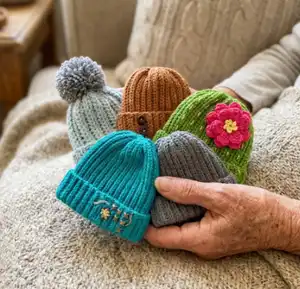
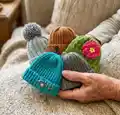
Make a custom beanie in whichever yarn weight you like with this flexible freestyle pattern. You will learn how to create a ribbed rectangle, work rows in the back loop for a neat ridge texture, shape the top with single crochet decreases, and finish the hat with a clean seam and optional embellishments. The pattern is perfect for personalizing with pompoms, buttons, embroidery, or studs — make it your own!
Progress Tracker
0% Complete
— Notes & Overview :
Info :
Making a beanie without a pattern is super simple! It can be very freeing to create something without having to follow someone else's directions to the T. Basic beanies make excellent gifts and have so much potential for personalization! Be sure to watch the live event for a full tutorial!
Info :
For this project, you can make a beanie in whichever yarn weight you like. Choose a hook that will give you a fairly firm gauge so that you do not have large holes between your stitches. Just to give you a frame of reference, I often use a worsted weight yarn (this is a #4) with a G/6 (4.0mm) hook, or a bulky yarn (#5) with an I/9 (5.5mm) hook or a super bulky weight (#6) with a K (6.5mm) or L (8.0mm) hook.
Info :
Yarn usage is dependent on the thickness and type of yarn that you choose as well as the size of the beanie, how far the bottom of the hat is folded up, and gauge. Just for a ballpark idea of how much yarn is needed, I've listed my averages here for different yarn weights for a medium adult sized hat. You will need extra for a larger hat, less for a smaller hat, etc.
Round 1 :
Worsted weight (#4): approximately 290 yds (medium adult hat)
Round 2 :
Bulky weight (#5): approximately 225 yds (medium adult hat)
Round 3 :
Super Bulky weight (#6): 190 yds (medium adult hat)
Info :
Next, determine how tall you would like your hat to be. You can use a beanie that you already own and measure it from the top to bottom, or you can use your head to determine this measurement. To use your head, use a measuring tape to measure where the bottom edge of the hat should be and measure up to where you imagine the center top of the hat should be.
Info :
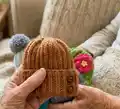
If you plan the hat to have a folded brim like the sample shown, you will need to add the height of the brim to the projected height of the hat. For instance, I wanted my rust colored hat to measure about 8" [20.5cm] tall and I wanted the brim to measure about 3" [7.5cm] up from the folded edge. So the total height of my hat should be 11" [28cm]. (The rust colored sample was made to fit a child, with a bit of extra height to the hat).
Round 4 :
Make a beginning chain that is just slightly longer than the desired beanie height by about 1" [2.5cm], then add 1 more stitch (this will count as a turning chain). In the worsted weight, rust colored sample I started with 49 chains.
Round 5 :
Beginning with the second chain from hook and working into the bottom of the chain, make a HDC (see note below) in each st across, until the piece is as long as your targeted height measurement.
Round 6 :
If there are extra chains leftover, these can be unraveled. As you continue making rows, continue to monitor the width of your rows (this is the height of the finished hat). Sometimes our gauge fluctuates a bit at the start of our project so it is important to double check after a few rows to make sure it is on target.
Info :
Note: Alternatively, you can begin with a SC row instead of a HDC row. I like to do this because then the first row + the foundation chain add up to be about the same height as 1 row of HDC. This means that this first row will blend in a bit better when we seam the hat together at the end.
Round 7 :
Next, *make a ch-2 for a turning chain (this will not count as a stitch - you will never work into these turning chains), turn your work and make 1 HDC in the back loop of each stitch across.
Round 8 :
Repeat from * until your hat is the desired circumference (you will need to measure across the long sides of the rectangle, or you can pin the shorter ends to each other and try it on). The long side of the rectangle should measure 1-3" [2.5-7.5cm] smaller than the head circumference so that it has to stretch a bit to fit. Make sure you work an even amount of rows; the working loop should be opposite where the beginning yarn tail is when you are finished.
Round 9 :
In my rust colored sample I worked 50 rows.
Info :
Rotate the piece in order to work along the top edge of hat, into the row-ends. Make SC decreases (SC2tog) as shown, across the top edge to help shape the top edge.
Round 10 :
To make the decreases across the top edge, **insert hook into the next ridge (see photo) YO, and pull up loop, insert hook into following ridge, YO and pull up loop...
Round 11 :
YO and pull through all 3 loops on hook.
Round 12 :
Repeat from ** across until all ridges have been worked. If one ridge remains at the end, work one SC into the last ridge.
Info :
Fasten off leaving a long tail for sewing. Using yarn needle, weave yarn tail through each of the SC that were worked along top edge of hat and pull tight to close the top of the hat.
Round 13 :
Continue to use the yarn tail to whip stitch the seam in hat.
Round 14 :
To make your seam blend in really well, insert needle under just the top loop of the last row worked, but under both loops of the foundation edge as shown below.
Round 15 :
Weave in ends. Block.
— Inspiration & Yarn Info :
Info :
Inspiration Yarn and project info for samples shown: Classic, no-frills, and lets the yarn speak for itself. This yarn is one of my favorite dependable, warm, workhorse, worsted weight yarns.
Round 16 :
Yarn used: Kelbourne Woolens Germantown (worsted weight (#4), 100% North American Wool; 220 yds [201m]/ 3.5 oz [100 grams]; Medium Gray Heather #030).
Round 17 :
Super squishy, with an oversized fluffy pompom looks so super-duper cute on kids of all ages (including you!). The pom-pom I used appears to have been discontinued, but something similar can be used.
Round 18 :
Yarn used: Buttercream Luxe Craft Alpaca Solid (super bulky weight (#6), 80% Acrylic, 20% Alpaca; 130 yds [119m]/ 6 oz [170 grams]: Light Blue #BCMA-421).
Round 19 :
For the cactus spine embroidery and flower centers I used 2 strands of a sock-weight yarn held together and a yarn needle to make long whip-stitches along each of the ridges; the spines were added on the WS of the hat near the bottom so that when it was turned upward the stitches would be on the outside.
Round 20 :
Yarn used: We Crochet Brava Bulky (bulky weight (#5), 100% Acrylic; 136 yds [m]/3.5 oz [100 grams]: Peapod #633894 AND Rouge #28353 for the flower.
Round 21 :
Scraps of sock yarn were used for stitched cactus spines and flower center: West Yorkshire Spinners Signature 4-ply fingering (#1), 75% Wool, 25% Nylon; 437 yds [400m], shown in Milk Bottle #230 and Butterscotch #240.
Round 22 :
Leather buttons have the power to elevate a basic beanie to librarian-chic in mere minutes; I used a needle and thread to stitch two 3/4" faux leather buttons through both layers of the beanie.
Round 23 :
Yarn used: WeCrochet Wool of the Andes (worsted weight, 100% Wool; 110 yards [100m]/ 1.75 oz [50 grams]: Amber Heather #23893).
Round 24 :
For studs and pins I added a small rectangle of black knit fabric hidden under the folded brim to secure studs and pin backing; pierced studs through both layers and fastened prongs inward, and attached enamel pin with a couple of safety pins if needed.
This Freestyle Beanie pattern invites you to make a hat that is uniquely yours, whether classic and simple or boldly embellished. Add pompoms, leather buttons, embroidery, studs, or keep it minimal—the choice is yours. Happy crocheting and enjoy making wearable, cozy creations! 🧶✨🧵