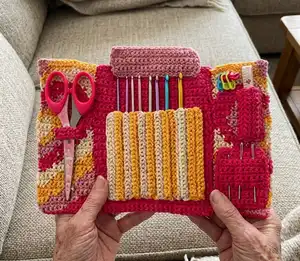
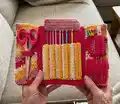
Make a colorful, practical crochet hook case using single crochet and intarsia color changes. This pattern guides you through planning, reading graphs, creating pockets and patches, and sewing everything together into a neat, portable case. Perfect for crafters who want a thoughtful project that improves colorwork and finishing skills. Follow the step-by-step instructions and tutorials included to customize the size and layout to fit your tools.
Progress Tracker
0% Complete
— Materials :
Info :
light/DK yarn. Yarn weight 3. I used 74g in total or 163m. 1st color: dark pink. 2nd color: light pink. 3rd color: beige. 4th color: yellow. 3.5mm crochet hook throughout the entire pattern. Scissors. Yarn needle. Measuring tape.
— Abbreviations :
Info :
US Terminology. CH - chain. SC - single crochet. FO - fasten off (cut yarn and secure). ST/S - stitch/stitches. TC - treble crochet. DC - double crochet. SLST - slip stitch.
— About the Pattern :
Info :
The case is made up using single crochet. For the color changes, I suggest using the intarsia method.
Info :
Intarsia guide: https://youtu.be/2iWqTPRQkWc or refer to next page. Feel free to use the "carry the yarn" method, but this may result to the carrying color peeking through. I highly suggest NOT to use the "fair-isle method" because the inside work should also be neat.
Info :
Skill Level: Advanced Beginners
Info :
The asterisks, * * are used to indicate the repeats.
Info :
Always CH1 for the turning CH in every row.
Info :
Gauge: 7cm x 7cm = 12STs x 14rows using SC, yarn weight 3 and 3.5mm.
Info :
This pattern is a one-size crochet hook case, suitable for a hook height of 15cm. Measurements of the case are provided below. If you want to customize the size, refer to the next page.
— How to Read a Graph :
Info :
Even rows: the wrong side of your work; this should be the inside of your case. ODD rows: the correct side of your work; this should be the outside of your case. EVEN rows (circle) are read from left to right. ODD rows (square) are read from right to left.
— How to do Intarsia :
Info :
Intarsia Tutorial: https://youtu.be/2iWqTPRQkWc. For Intarsia Method, when you are about to change color, you drop the current color, then bring up the other color and pull through with that color. You do not carry the dropped yarn with you, so it stays in that place until you have to use it again.
Round 1 :
SC until where you have to change colors.
Round 2 :
Drop the 1st yarn to the back, bring the 2nd yarn.
Round 3 :
LEAVE the 1st yarn behind, then continue SC using the 2nd color.
Round 4 :
When working on the wrong side, drop the yarn towards you; when working on the correct side, drop the yarn at the back. Continue SC with the working color.
— Planning Chart :
Info :
Use this non-colored digital sketch as a guide for you to choose colors and plan panel layout: left portion, middle portion, right portion and top flap and pockets. Follow the grids to map out intarsia color changes and pocket placements.
— Customize the Case Size :
Info :
By customizing the case size, you can extend as much as 12cm horizontally and vertically. In the original graph, 13 grids were used for width and 37 rows for the height of one half-heart portion; the graph below shows additional grids and rows for larger sizes.
Infos :
To customize or increase the size you: 1. Must follow the General Rules (#1 - #5). 2. May use a larger hook and/or 3. add more stitches/rows.
— General Rule :
Round 1 :
1. The middle portion is twice wider than right portion.
Round 2 :
2. Both right and left portion should have the same number of STs.
Round 3 :
3. All portions (middle, left, and right) should have the same number of rows.
Round 4 :
4. The size of the patches should not exceed any of the portions.
Info :
Example: If the right heart portion is 7cm wide, then the middle portion should be twice wider, so 7cm x 2 = 14cm. Or, middle portion = right portion + left portion.
— Step 1: Middle Portion :
Round 1 :
a. Grab the 1st color (dark pink). CH27. In the 2nd CH from hook, make 1 SC.
Round 2 :
b. *make 1SC in each st until the last st. CH1, turn.* repeat * to * until you have 37 rows.
Round 3 :
Info: The height should be (about 4cm) longer than your crochet hook. If it doesn't, add more rows.
Round 4 :
c. CH1, leave a long tail (worth the height of the middle portion) for sewing.
— Step 2: Right Portion :
Info :
We will be following the graph on the right for the right portion. The foundation CH does NOT count as a row.
Round 1 :
a. Grab the 1st color, CH14.
Round 2 :
b. Start row 1 by following the graph on the right. When you reach the last ST of the 37th row, FO.
Info :
Tip: If you want the inner to look neat, then try to make the wrong side neat as well.
— Step 3: Left Portion :
Info :
We will be following the graph on the left for the left portion. The foundation CH does NOT count as a row.
Round 1 :
a. Grab the 1st color, CH13.
Round 2 :
b. Grab the 2nd color and CH1 more. Reminder: Do not CH14, only do CH13 with 1st color, then do one more chain with 2nd color.
Round 3 :
c. Start row 1 by following the left graph. When you reach the last ST of the 37th row, FO.
— Step 4: Hook Pockets :
Round 1 :
2 rows of SC are allocated for 1 crochet hook. However, for crochet hooks 5mm, 5.5mm, 6mm and above, 3 rows will be allocated for each hook.
Round 2 :
For ergonomic crochet hooks, you may want to have 4 (or more) rows for 1 crochet hook.
Round 3 :
a. Grab 3rd color, CH22, or when it reaches 11cm. In the 2nd ch from hook, 1SC.
Round 4 :
b. *make 1SC in each ST until the last ST. CH1, turn.* repeat for another row.
Round 5 :
c. Repeat Step 4b, changing colors for 7 times. When you reach the last ST, grab the opposite color and pull through.
Round 6 :
d. When you reach the last ST, grab the opposite color, and pull through. SC for 3 rows - CH1 for turning CH.
Round 7 :
e. After 3 rows, cut yarn, and repeat Step 4d for 2 more sets - you should have 3 sets total of 3 rows. FO.
— Step 5: Other Patches :
Info :
We will now make patches for the stitch markers, needles, measuring tape, scissors, and a cover for the hooks.
Round 1 :
a. Follow the guide below, or customize the patch length according to your liking. CH1 more for the foundation CH. CH1 for turning CH for every row. FO after reaching the last row, leaving enough tail for sewing.
Round 2 :
Info: Refer to the measurements provided on page 4 for the patch lengths. Example patch counts shown: 23SC each row, 7 rows total for hook pocket cover; 1SC each row, 7 rows total for small top pocket; 6SC each row, 10 rows total for measuring tape pocket; 10SC each row, 14 rows total for needle pocket. Adjust rows if your tools are thinner or thicker.
— Step 6: Sewing :
Info :
The sewing part will take most of your time, so be patient. I switched the location of the measuring tape patch, and disregarded the middle patch at the right side.
Round 1 :
a. Sew the following patches, in your preferred way, according to the guide on the next page. I used the mattress stitch to sew the panels and running stitch for the patches.
Round 2 :
Info: Mattress Stitch Tutorial: https://youtu.be/LsFjyL_YX4M?t=39. Running Stitch Tutorial: https://youtu.be/W4nhj8kMpAI.
Round 3 :
Info: Very important reminder: do not let the sewing thread be visible on the outside, especially when you are using a thread color that is different to the other patch.
Round 4 :
Sewing tips: 1. I separated the ply of the yarn to create a thinner thread. 2. For the sewing parts going up/down, I sewed through the yellow highlights. 3. For the sewing parts going right/left, I sewed like I'm weaving ends.
Round 5 :
Sewing guide: same color of the solid and broken lines are sewn together. Pin parts and check placement before sewing. Cut and weave ends neatly when finished.
— Step 7: Lock :
Info :
In order to secure the case, we need a lock. You may find other ways on how you want to secure the case, but I made a heart string.
Round 1 :
Abbreviations (US): TC - treble crochet. DC - double crochet. SLST - slip stitch.
Round 2 :
Heart: a. Grab the 3rd color yarn, make a magic ring. CH2, make 3 TC into the ring, then 3 DC, then CH 1. 1TC into the ring. CH1, 3DC into the ring, then 3TC. CH2, SLST into the ring.
Round 3 :
String: b. Make 1SLSTs each in the 2CHs, then another 1SLST each in the next 4STs. Then, CH enough for the string. I made mine about 13in. FO.
Round 4 :
c. Attach yarn at the pink dot below. 1SLST each in the next 4STs. Then, CH enough for the string. FO.
— Finishing :
Info :
And your Case is finished! Make sure to cut your weaved ends. Thank you so much once again for showing your support!
This crochet hook case pattern combines functional storage with colorful intarsia design and practical pocket layouts. It is perfect for gifting or treating yourself to a custom tool organizer with personality and charm. Make it in your favorite palette and enjoy a neatly finished handmade case! 🧶✨