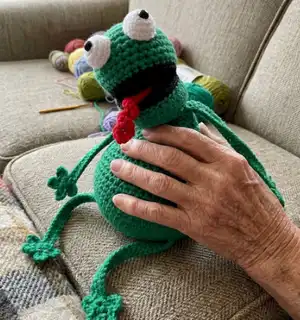
🧢 Beautiful ✨ Detailed πŸ’ Adorable

Crochet Frog Door-Stopper Pattern

Crochet Frog Door-Stopper Pattern
4.5β˜… Rating
5-7 Hours Time Needed
3.8K Made This
βœ‚οΈ

Intermediate Level

Ideal for those with basic crochet experience, featuring slightly more advanced stitches and techniques to expand your skills.

⏱️

Weekend Treat

Takes 5-7 hours, making it an enjoyable project to finish over a couple of days.

πŸ₯

Charming Critter

Delightful animal designs with sweet details that capture the essence of your favorite woodland and farmyard friends.

About This Crochet Frog Door-Stopper Pattern

This pattern creates a stuffed crochet frog door-stopper with a weighted body and playful details. You will crochet separate pieces β€” head (top and bottom), body, eyes, tongue, arms, legs and neck β€” and assemble them for a cute, functional piece. Techniques include working in rounds, increases/decreases, back loop rows, and simple surface assembly.

Crochet Frog Door-Stopper Pattern crochet pattern - detailed view of completed project

Clear round-by-round instructions and materials list are included for each part to guide you from start to finish. Ideal for crafters comfortable with basic amigurumi techniques and ready to try a slightly larger, weighted project.

Why You'll Love This Crochet Frog Door-Stopper Pattern

I absolutely love this pattern because it turns simple yarn and basic stitches into a playful, functional door-stopper that brightens any room. I enjoy how the design balances structure and whimsy β€” the weighted body keeps doors steady while the expressive head adds personality. I also love that the pattern uses minimal extra yarn for details like the tongue and mouth, so it is economical to make. Sharing this pattern brings me joy because it encourages crafters to create something both useful and adorable.

Crochet Frog Door-Stopper Pattern step 1 - construction progress Crochet Frog Door-Stopper Pattern step 2 - assembly progress Crochet Frog Door-Stopper Pattern step 3 - details and accessories Crochet Frog Door-Stopper Pattern step 4 - final assembly and finishing

Switch Things Up

I love how easily you can customize this frog β€” change the green to teal or lime for a fresh look.

If you want a chunkier, cuddle-friendly version, use bulky yarn and a larger hook to increase the size and texture.

To make a tiny keychain version, switch to fingering or sport weight yarn and a smaller hook and reduce stuffing and beads.

Try embroidering freckles or spots on the back using a contrasting yarn for extra character and personality.

Swap the safety eyes for embroidered eyes if making the frog for very young children or if you want a softer finish.

Add a small ribbon or a tiny crocheted bow to the neck for a gift-ready presentation or seasonal decoration.

Use different color combinations for the mouth and tongue β€” a pale pink tongue or a darker mouth lining will change the expression.

For extra durability, sew an inner lining of felt or fabric inside the mouth to help it keep its shape and protect the yarn edges.

Experiment with adding wire to the limbs for posability, wrapping it in tape before inserting to protect the yarn and stuffing.

I sometimes create matching mini frogs by changing yarn weight and adjusting bead amounts to make a set of door-stoppers at different sizes for a coordinated look.

Common Mistakes & How to Fix Them

βœ— Skipping the bead bag insertion can make the door-stopper tip over or be too light; insert the bead bag for weight before the opening becomes too small and secure it inside the stuffing. βœ— Forgetting to change color exactly where indicated will make the mouth or head color look uneven; follow the color change notes and switch yarn at the specified round for a neat edge. βœ— Not using the back loop only row as instructed will hide the intended ridge; work ROW 6 in the back loop only to create the correct shaping and texture. βœ— Failing to stuff gradually causes lumps and uneven shaping; add stuffing in small amounts while shaping and continue stuffing as you decrease to keep a smooth surface. βœ— Attaching parts without pinning first can create asymmetry; pin the eyes, neck, arms and legs in place and check positioning before sewing to ensure correct placement.

Crochet Frog Door-Stopper Pattern

Make a charming crochet frog door-stopper to brighten your home and keep doors in place. This pattern gives you full step-by-step instructions so you can crochet the head, body, legs, arms, neck and fun details like eyes and a tongue. Perfect as a handmade gift or a playful home accent β€” follow the clear rounds and assembly notes to finish a sturdy, adorable frog.

Intermediate 5-7 Hours

Materials Needed for Crochet Frog Door-Stopper Pattern

β€” Main Fabric

  • 01
    Worsted weight yarn (#4) - green: one skein is plenty for body and parts
  • 02
    Worsted weight yarn (#4) - black: very small amount for mouth
  • 03
    Worsted weight yarn (#4) - white: small amount for eyes
  • 04
    Worsted weight yarn (#4) - red: very little amount for tongue
  • 05
    Safety eyes - 10 mm (2 pieces)
  • 06
    Stuffing - polyester fiberfill for shaping
  • 07
    Stuffing beads or plastic pellets for weight (use inside nylon stocking/mesh bag)
  • 08
    Nylon stocking or mesh bag to hold beads

β€” Tools Required

  • 01
    Crochet hook size G (4.0 mm)
  • 02
    Safety eyes 10 mm (2 pieces)
  • 03
    Scissors
  • 04
    Yarn/tapestry needle for sewing pieces together
  • 05
    Stitch markers
  • 06
    Measuring tape
  • 07
    Darning needle
  • 08
    Stuffing (polyester fiberfill)
  • 09
    Stuffing beads or pellets for weight
  • 10
    Nylon stocking or small mesh bag for beads
  • 11
    2 round buttons size 2 1/4" OR thick cardboard cut to that size (used in mouth to keep flat)

Progress Tracker

0% Complete

β€” Top of Head :

Row 1 :

With black yarn, use the magic circle method if you choose OR chain 2 and single crochet 6 in first chain space (6)

Row 2 :

(increase row) sc 2x in each stitch from row one *inc x 6* around (12)

Row 3 :

(increase row) sc 2x in first stitch then (once) 1sc in next stitch, *inc then 1sc* around (18)

Row 4 :

(increase row) sc 2x in first stitch then 1sc in next 2 stitches *inc, 1sc, 1sc* around (24)

Row 5 :

(increase row) sc 2x in first stitch then 1sc in next 3 stitches *inc, 1sc, 1sc, 1sc* around (30)

Info :

CHANGE TO GREEN YARN

Row 6 :

BACK LOOP for this row only sc around each stitch (no increasing) (30)

Row 7 :

sc around each stitch (no increasing) (30)

Row 8 :

sc around each stitch (no increasing) (30)

Row 9 :

sc around each stitch (no increasing) (30)

Row 10 :

sc around each stitch (no increasing) (30)

Row 11 :

sc around each stitch (no increasing) (30)

Info :

insert button here or cutout cardboard piece to keep flat - secure it if you choose, I secured my button by sewing it on with the final knot inside so you can't see it from the outside

Row 12 :

(decrease row) 1sc in next 2 stitches then decrease *1sc, 1sc, dec * x 7 sc in last 2 stitches (23)

Row 13 :

(decrease row) 1sc in next 2 stitches then decrease *1sc, 1sc, dec * x 5 dec and 1sc in last 3 stitches (17)

Row 14 :

sc around each stitch (no dec / inc) (17)

Info :

insert bead bag here for weight before it gets too small of an opening **you will be putting regular stuffing to finish off the "stuffing of the head" after the bean bag. Keep stuffing as we decrease. If your stitching is loose and you see the white stuffing or bean bag, you can also use the same colour green yarn to stuff it. We are not using too much yarn so it's not a big expense to use yarn to stuff the head**

Row 15 :

(decrease row) decrease then 1sc *dec and 1sc * x 5 then one more decrease (11)

Row 16 :

(decrease row) decrease x 5 then sc in last stitch *dec x5 * then 1sc (6)

Row 17 :

cinch last 6 stitches together tightly and finish off

β€” Bottom of Head :

Row 1 :

With black yarn, use the magic circle method if you choose OR chain 2 and single crochet 6 in first chain space (6)

Row 2 :

(increase row) sc 2x in each stitch from row one *inc x 6* around (12)

Row 3 :

(increase row) sc 2x in first stitch then (once) 1sc in next stitch, *inc then 1sc* around (18)

Row 4 :

(increase row) sc 2x in first stitch then 1sc in next 2 stitches *inc, 1sc, 1sc* around (24)

Row 5 :

(increase row) sc 2x in first stitch then 1sc in next 3 stitches *inc, 1sc, 1sc, 1sc * around (30)

Info :

CHANGE TO GREEN YARN

Row 6 :

BACK LOOP for this row only sc around each stitch (no increasing) (30)

Row 7 :

sc around each stitch (no increasing) (30)

Row 8 :

sc around each stitch (no increasing) (30)

Row 9 :

sc around each stitch (no increasing) (30)

Info :

insert button / cardboard piece **I recommend using green yarn to stuff the remainder of the bottom of the head**

Row 10 :

(decrease row) *dec, 1sc * x 10 (20)

Row 11 :

(decrease row) *dec, 1sc * x 10 (10)

Row 12 :

cinch the remainder 10 stitches tightly, finish off

β€” Tongue :

Item :

using RED yarn Chain 25, turn, 3sc in first chain from hook, sc in next chain, repeat until there is 5 chains remaining. SC in last 5 chains. Finish off

β€” Eyes :

Info :

using WHITE yarn, make 2

Row 1 :

using the magic circle OR chain 2 and sc x5 in first chain space

Row 2 :

(increase row) 2sc in each stitch (10)

Row 3 :

sc around (10)

Row 4 :

sc around (10)

Info :

finish off

Info :

INSERT safety eyes in the top of the eyes made. When using the chain 2 method you end up with a tiny "hole" in the top of the eyes perfect for inserting the safety eyes. No they are not too big for the safety eyes to fall out if secured properly

β€” Body of Frog :

Row 1 :

Using the magic circle method if you choose OR chain 2 and single crochet 6 in first chain space (6)

Row 2 :

(increase row) sc 2x in each stitch from row one *inc x 6* around (12)

Row 3 :

(increase row) sc 2x in first stitch then (once) 1sc in next stitch, *inc then 1sc* around (18)

Row 4 :

(increase row) sc 2x in first stitch then 1sc in next 2 stitches *inc, 1sc, 1sc* around (24)

Row 5 :

(increase row) sc 2x in first stitch then 1sc in next 3 stitches *inc, 1sc, 1sc, 1sc * around (30)

Row 6 :

(increase row) sc 2x in first stitch then 1sc in next 4 stitches *inc, 1sc, 1sc, 1sc, 1sc * around (36)

Row 7 :

(increase row) sc 2x in first stitch then 1sc in next 5 stitches *inc, 1sc, 1sc, 1sc, 1sc, 1sc * around (42)

Row 8 :

(increase row) sc 2x in first stitch then 1sc in next 6 stitches *inc, 1sc, 1sc, 1sc, 1sc, 1sc, 1sc * around (48)

Row 9 :

sc around (48)

Row 10 :

sc around (48)

Row 11 :

sc around (48)

Row 12 :

(decrease row) dec then 1sc in next 6 stitches *dec, 1sc, 1sc, 1sc, 1sc, 1sc, 1sc * 6x (42)

Row 13 :

sc around (42)

Row 14 :

(decrease row) dec then 1sc in next 5 stitches *dec, 1sc, 1sc, 1sc, 1sc, 1sc * 6x (36)

Row 15 :

sc around (36)

Row 16 :

sc around (36)

Row 17 :

sc around (36)

Row 18 :

(decrease row) dec then 1sc in next 4 stitches *dec, 1sc, 1sc, 1sc, 1sc * 6x (30)

Row 19 :

sc around (30)

Row 20 :

sc around (30)

Info :

** start stuffing body as we'll be decreasing more and more. You can also insert another bean bag here for weight as well. My stitching is on the tighter side so I didn't need to use yarn to stuff the body here. You can - it's ok **

Row 21 :

(decrease row) dec then 1sc in next 3 stitches *dec, 1sc, 1sc, 1sc * 6x (24)

Row 22 :

(decrease row) dec then 1sc in next 2 stitches *dec, 1sc, 1sc * 6x (18)

Row 23 :

(decrease row) dec then 1sc *dec, 1sc * 6x (12)

Row 24 :

decrease around x 6 (6)

Row 25 :

cinch around last 6 stitches and finish off

β€” Arms and Legs :

Item (make 2 of each) :

green yarn Chain 21, turn

Row 1 :

sc in chain closest to hook (20)

Info :

once at the end - do not finish off - chain 6 and slip stitch to the first chain, repeat that 3 more times to end up with 4 "finger / toes"

Info :

finish off after the 4th slip stitch. Sometimes there will be a small hole where you did your slip stitches, sew up with the yarn tails once you have finished off

β€” Neck :

Item :

green yarn (works out to approx 6" before folding) Chain 27, turn

Row 1 :

HDC starting in 2nd chain from hook (25)

Row 2 :

HDC 4 more rows

Info :

Since the neck is constantly on the floor, I have made it this long so that I can fold over to make it thicker - sew up the sides; sewing up the bottom not so important as we will be attaching this to the body.

β€” Assembly :

FIRST :

Sew the tongue to the back of the bottom of head. Sew it up to the centre of the black circle so it doesn't move that much

SECOND :

you will now be sewing the top and bottom parts of the head together. You will only sew it over 10 stitches as you want to make sure the, now mouth, works.

Info :

Shown without the tongue attached as I was crazy before I put the head together and didn't sew the tongue in first - that's why I know you should and I've instructed you to do this :)

THIRD step :

Attach eyes to top of head

FORTH step :

Lets sew the legs onto the frog body. Place them on the bottom of the larger part of the body. As well, lets sew the neck onto the top of the body.

FIFTH step :

Sew the arms onto the neck. Place them about a half inch from the top of the neck as we still have to sew the neck and head together

SIXTH step :

We're here - lets sew the neck onto the bottom of the head - in the middle

Info :

WE ARE DONE !!

Assembly Instructions

  • Sew the tongue to the back of the bottom of the head and secure it to the center of the black mouth circle so it does not move.
  • Sew the top and bottom parts of the head together, sewing over only 10 stitches so the mouth can open and close properly.
  • Insert and secure the bead bag for weight into the head and body before the opening gets too small, then finish stuffing and close.
  • Attach eyes to the top of the head (insert safety eyes into the hole left by chain-2 method if used), then sew into place securely.
  • Sew legs onto the bottom of the larger part of the body and sew the neck onto the top of the body, positioning for balance.
  • Sew arms to the neck about a half inch from the top of the neck, then sew the neck to the bottom of the head in the middle for final assembly.

Important Notes

  • πŸ’‘Use stitch markers to keep track of the first stitch of each round, especially during increases and decreases.
  • πŸ’‘Insert bead bags or pellets for weight before the opening gets too small and enclose them inside a nylon stocking or mesh bag.
  • πŸ’‘Stuff gradually while decreasing to avoid lumps and to maintain the shape; finish stuffing after the bead bag is in place.
  • πŸ’‘When changing colors, secure ends and weave them in neatly to prevent fraying and to keep the mouth and head edges tidy.

This playful Crochet Frog Door-Stopper is both functional and adorable β€” a handmade accent that holds doors steady and sparks smiles. Whether you make it for your home or as a gift, the weighted body and expressive head give it personality and purpose. Follow the clear round-by-round instructions to complete each piece and assemble a durable, lovable frog. 🐸🧢

You ask,

we answer.

FAQs

What size will the finished piece be?

The finished door-stopper measures approximately 10-12 inches long when using worsted weight yarn and a G hook, though exact size will vary slightly with your tension.

Can I use different yarn weights for this pattern?

Yes, you can use different yarn weights but the final size and the amount of filling and beads will change; choose an appropriate hook size for your yarn weight.

Do I need prior crochet experience for this pattern?

This pattern is rated intermediate, so basic knowledge of working in rounds, increases and decreases, and simple assembly is recommended for best results.

How do I add weight to the door-stopper?

Place stuffing beads or pellets into a nylon stocking or mesh bag and insert them into the body (and head if desired) before closing the openings to add stable weight.

Can I omit the bead bag and only use stuffing?

Yes, you can omit the bead bag and use only fiberfill, but the door-stopper will be much lighter and less effective at holding heavy doors open.